
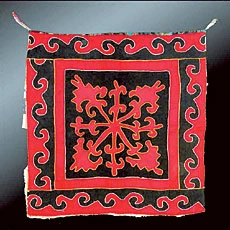
A nomadic people originating in Siberia and settling in Central Asia, the Kyrgyz have an increasing cultural presence in American museums, thanks to the unique beauty of their applied arts.
For thousands of years, Kyrgyz artisans have contributed to Central Asia ‘s reputation as the land of textiles. Their traditional lifestyle of wandering herdsmen limited their crafts and even their dwellings to portable items. The principal raw materials of their decorative arts are derived from hunting and livestock breeding — wool, leather, bone and horn. Traditional Kyrgyz art includes patterned weaving, thick felt carpets and clothing, woolen carpets, leather items, wickerware, carved wood, ornamental metalwork, and the figured and patterned clay, bone, and brick decorations of gumbez, or funerary monuments.
Kyrgyzstan has long been an isolated land, for both geographical and historical reasons. Ninety-four percent of the country is mountainous. Nearly half its terrain is at an altitude of over 3000 meters, and a third of the country is under permanent snow and glaciers.
Under Soviet rule (1918-1991), most of Kyrgyzstan was closed to foreigners. Its strategic location at the heart of Central Asia made it an ideal location for military bases and defense research. Lake Issyk-Kul, a large, deep mountain lake that never freezes, was the home of a secret naval weapons development complex. The Tian Shan or “Heavenly Mountains” abound in uranium and other metals, constituting another strategic asset. Only Russian miners sent by the Soviet government were allowed to work in the well-guarded mining areas.
But for thousands of years, Kyrgyzstan was a meeting place of many cultures, despite its challenging geography. The Kyrgyz people were originally natives of the Yenisei River Valley in Siberia, where archeologists have found Bronze Age weapons and tools bearing their distinctive geometrical designs. Around 800 A.D., the Kyrgyz nomads began migrating across the Siberian steppes to mountainous Central Asia.
The Scythians, Sogdians, and the troops of Alexander the Great spent time in Kyrgyzstan, leaving their cultural imprint. Symbolic zoomorphic motifs like that of the Sogdian sacred pheasant were incorporated into the design vocabulary of local weavers. From antiquity through the Middle Ages, several of the Silk Road caravan routes passed through Kyrgyzstan, providing varied artistic, commercial, and spiritual influences from China, Persia, and the Middle East.
From 900 to 1200 A.D., the Kyrgyz were ruled by the cultured Turkic Karakhanids, who brought Islam to Central Asia. Conquests by the Mongols, the Manchus, and the Russians followed, but throughout the ages, the Kyrgyz have remained Muslim. Thus the Islamic artistic heritage, including Arab calligraphy, ornate leather bookbindings, and mosque architecture and design, became a part of the Kyrgyz tradition.
There are currently 80 distinct ethnic groups living in the country, and only sixty percent of the people are ethnic Kyrgyz. This tolerant and independent society is a source of pride to the Kyrgyz people. Their country was the first Central Asian republic to obtain independence from the Soviet Union, in 1991.
A characteristic Kyrgyz creation is the shyrdak, a heavy rug made from pounded felt, with appliqued colored panels that are hand-stitched with camel thread. The rugs are assembled in the summer after the annual process of washing, drying, and dyeing the sheared sheep wool is complete. Three common decorative patterns are the kochkor mujuz or plant motif, the teke mujuz or ibex horn motif, and the kyal or scrollwork motif.
It is said that each crafted item reflects the long history of the Kyrgyz people, and that the woven and carved designs of Kyrgyz household objects create a symbolic, magical universe of poetry, spirituality, and the beauty of nature.
The most enduring emblem of Kyrgyz culture is The Epic of Manas, the national poem, known as the “Iliad of the Steppes.” The fruit of an age-old Central Asian oral tradition, The Epic of Manas tells of the founding of a democratic, multiethnic Kyrgyz state by a semi-legendary hero, the khan or batyr Manas. Brave, charismatic, and a fervent Muslim, Manas leads his people to freedom.
Though it is the most celebrated narrative of Turkic cultures, illustrating the customs and ideals of the region, The Epic of Manas has been overlooked by Western scholars. In Kyrgyzstan, the tale has been preserved for a thousand years by the manaschis, bards who recite the poem at public gatherings, adding their own embellishments, details, and explanations. Comprising more than half a million lines, The Epic of Manas was not written down until the 19th century. In 1995, the newly independent Kyrgyz Republic held a week-long international fair called “Manas 1000” to commemorate the millennial anniversary of the epic, and to reassert Kyrgyz national identity.
American museums have been increasingly successful in presenting non-Western art in attractive and accessible ways. The Textile Museum in Washington, D.C. (www.textilemuseum.org) supplements its displays of Central Asian art with one of the country’s most complete selections of documentation on textiles, in their bookstore and online. The Antonio Ratti Textile Center at New York’s Metropolitan Museum (www.metmuseum.org) also possesses excellent examples of Kyrgyz textiles.
In 2003, the Los Angeles County Museum of Art presented a well-researched exhibit called “The Legacy of Genghis Khan: Courtly Art and Culture in Western Asia, 1256-1353” that can be consulted on the Internet (at www.lacma.org/khan). More information about Central Asian art can be found at the Cleveland Museum of Art ( www.clevelandart.org) and the Asian Art Museum of San Francisco (www.asianart.org).
Little known until its independence from the Soviet Union, better known through recent political upheavals in Central Asia, the country of Kyrgyzstan has a proud artistic and cultural heritage waiting to be discovered.