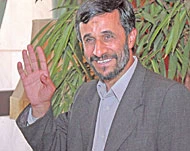
TEHRAN, 26 June 2005 — Ultraconservative Tehran Mayor Mahmoud Ahmadinejad swept to a stunning landslide victory in presidential elections yesterday and immediately vowed to turn Iran into a strong and exemplary Islamic state.
Ahmadinejad, 48, won the backing of the poor to defeat veteran political heavyweight Ali Akbar Hashemi Rafsanjani, who was supported by pro-reform parties and wealthy Iranians fearful of a hard-line monopoly on power in the country.
“Our main goal today is to create an exemplary, advanced and powerful Islamic nation,” he said in a radio address — his first comments since being declared winner of Friday’s election.
In a campaign where Rafsanjani advocated better ties with the United States, Ahmadinejad had said relations with Washington were not a cure-all for Iran.
“This all but closes the door for a breakthrough in US-Iran relations,” said Karim Sadjadpour, Tehran-based analyst for the International Crisis Group.
Washington broke ties with Iran in 1980 and now accuses it of developing nuclear weapons and supporting terrorism. Iran, the world’s fourth-largest oil producer, denies the charges.
Ahmadinejad, who will be Iran’s first non-cleric president for 24 years when he takes office in August, has also used firm language on Iran’s controversial nuclear program, saying it was the nation’s right to develop its nuclear technology.
Iran says its nuclear program is to make electricity but the West fears it wants to make atomic weapons.
Ahmadinejad’s win was unlikely to lead to immediate changes in nuclear policy, as the final word in that and other matters of state lies with supreme leader Ayatollah Ali Khamenei.
In his victory speech, Ahmadinejad hinted at a shake up in the oil sector, saying oil deals needed to be clarified. But amid rumors that he will purge government ministries after many top officials backed his opponent, he stressed the need for unity in the nation of 67 million.
“Today is a day when we have to forget all our rivalries and turn them into friendships,” Ahmadinejad said.
The vote was a crushing blow for Rafsanjani, 70, who has been at the forefront of politics since the 1979 revolution and was hoping to regain the post he held from 1989 to 1997.
Final results gave Ahmadinejad 61.69 percent against Rafsanjani’s 35.92 percent. Turnout of the 46.8 million eligible voters was reported at 59.72 percent, slightly lower than last week’s first round of the vote.
Khamenei said the United States had been “humiliated deep inside” by the Iranian people’s verdict. “Despite its babbling, your enemy is now humiliated deep inside because of your greatness and the transparency of your democracy,” Khamenei said in a statement read out on state television.
He congratulated Ahmadinejad and offered condolences to Rafsanjani. He hoped Rafsanjani would still play a role in the country’s politics.
In his first public reaction, Rafsanjani alleged that “all the means of the regime were used in an organized and illegal way to intervene in the election”.
“I do not intend to file a complaint to jurists who have shown that they cannot or do not want to do anything. This I will leave to God,” he was quoted as saying by the ISNA news agency.
The West reacted warily to the poll outcome.
British Foreign Secretary Jack Straw was sharply critical of the vote, saying there were “serious deficiencies” in the way it was run.
German Foreign Minister Joschka Fischer expressed similar concerns in an open letter to be published in the Bild am Sonntag weekly today.
In Washington, White House spokeswoman Maria Tamburri said that the United States was concerned about the fairness of the elections.
“We have expressed our clear concerns about the recent elections where over 1,000 candidates were disqualified from running, and there were many allegations of election fraud and interference,” she said. “We continue to stand with those who call for greater freedoms for the Iranian people.”