
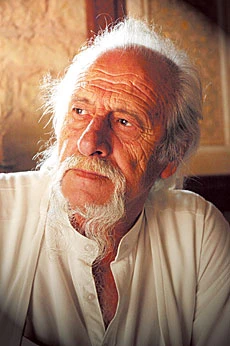
There is every chance that your contribution to life is going to be minimal if you are born dead. You will reduce it further, having overcome that hurdle, by moving to Agadir, a city devastated in 1960 by a severe earthquake — as an architect. That, however, would be to underestimate the power of dreams and the steely determination of a man with the unlikely name of Coco Polizzi. The outcome of his extraordinary life is the building of a medina (walled village) in Agadir using the materials and techniques of centuries ago.
At 6 a.m. on Sept. 19, 1941 in the city of Rabat, Beato Salvatori Polizzi came into this world and was pronounced dead. His sister wanted to name him Claude and so “Coco” he subsequently became. His childhood was spent divided between living with his nurse and the bedroom/office of his architect brother, twenty years his senior. He slept on the roshan (wooden screen)-covered balcony of his nurse’s apartment. “I lived with the noise of the souk and medina day and night,” he said.
In his brother’s office, Polizzi discovered books on architecture. “I became fascinated by pictures and designs. They totally absorbed me and set me thinking and imagining.” By the time he was eight, the childish scribblings of had become his first architectural drawings. Though talented, school work was not his forte and he was removed at the age of 13 for inability in math.
In 1955, just a year later in France where his family had moved, he was working for a celebrated firm of Nice-based architects who had spotted his potential. On the then substantial wage of 7000 francs per month, he developed skills in reading and drawing plans that allowed him to create properly proportioned artist’s impressions of finished buildings.
After a time in France, the family moved back to Morocco and the young man worked with his father in the family construction business. “We made most of our own building materials,” he said “Bricks, trimmed and carved wood and stone and architectural fittings.” The firm built modern buildings and used concrete and steel as well as more traditional materials, but Polizzi involved himself in the process of creation and picked up the artisans’ skills and the feel for traditional materials that were to serve him so well later. He designed furniture in traditional Moroccan styles and using the family workshops, made it himself.
In 1970 the family moved again to France but very soon after, Polizzi’s father suffered a heart attack and insisted on returning to Morocco. “He did and when he arrived, he tore up his passport, kissed the earth and vowed never to leave again. He died the next day.”
The loss had a profound effect on Polizzi who returned to Agadir and lived on his own for six months. It was ten years after the earthquake which, in a few seconds, had completely destroyed Agadir. “Even so, ten years after the earthquake, there were only two hotels and seventy cars. No one wanted to live here; the place was a ghost town.”
The threads of Polizzi’s past life came together during this period. The manual building and craft skills he had learned in the family firm, the conceptual and artistic skills and architectural ability were exactly what was necessary to build a new medina from the rubble of Agadir. Thus an idea was born — to build a new “old” medina using traditional skills and bring to the new medina, craftsmen who would be a living heritage.
To transform noble visions into hewn stone and buildings takes more than a little money, support from local authorities and land to build on. Over the next thirteen years or so, Polizzi kept the plan alive while working on projects in Agadir, France and, significantly as it turned out, Saudi Arabia. While working in Jeddah, he met and became friends with Tarik Alireza who became fascinated by, and then involved, in the idea. In Polizzi’s mind the medina existed; the image had only to be replaced with wood and stone. In 1983 he built his own workshop in Agadir, partly to supply his business but also to take the first step toward realizing his dream. He produced plans and drawings for the project while designing and building hotels and housing during the construction boom that resulted in modern Agadir.
A major step in bringing the project to fruition was to get government backing. It took persistence. For eight months, day after day, Polizzi sat outside the office of the wali of Agadir Province without success. His perseverance eventually paid off; Abdul Kareem Laroussi looked at, understood and agreed to the idea. “Looking me squarely in the eye,” said Polizzi, “he said, ‘I will sign this for you, but do not bring shame on me, do not let me down. Make something we can be proud of.”’
That was the beginning of Polizzi’s project. A four and a half hectare site was leased and using his own capital, the medina began to take shape in 1992. It is built along traditional lines. The only concessions to modernity are the plumbing and some electricity. It is built entirely of bricks made on site, hewn stone and wood. “There isn’t a reinforcing bar in the place,” said Polizzi. His experience working with the family firm and honed over the years as an architect now provide him with the skills to build an entire medina, down to the furniture and lamp fittings. The site workshops produce nearly everything, from the bricks for building to the mosaics that decorate the floors and walls of the buildings and the intricately carved doors and roshans.
Gradually the medina took shape but after four years, the money ran out. Polizzi told the workers that there was enough for one more month and then the project would stop. “We got through it,” said Alireza, “but it was close.”
“The fact that we do good for those involved is great; then everyone wins,” he said, “It’s absolutely designed for profit. It is not meant to be a charity; we make money and we plough it back in and do other things.”
When Alireza and Polizzi teamed up, they had each spotted a gap in the tourist market - tourists wanted something more than just the sand and sun for which Agadir was famous. “Agadir was ideal because there was nothing here and that sort of attraction was completely missing.”
The medina has succeeded; within the last year the Wali of Marrakesh, which has its own famous medina, has asked Polizzi and Alireza to build one there. “These are commercial ventures,” said Alireza. “They satisfy cultural, artistic and commercial imperatives. We do tourism with a social aspect. It’s a heady combination and it works.”
The concept of a modern ‘old village’ has come a long way since it was originally proposed and greeted with disbelief. The government is fully behind the scheme; the medina in Marrakesh is now close to ground-breaking and at least two others are planned. Morocco’s tourist industry has taken off. “There is a kind of challenge from the King — 10 million tourists within 10 years,” said Alireza. “Everything — investment policies and getting permits —is geared to achieving it.”
The project is already having a significant impact on the artisans of Agadir and will, when the project is complete, have considerable impact on artisans all over the country.
The nearest most tourists get to a craftsman, said Alireza, is the “bazaarist” who sells his work and is at the end of a chain of middlemen living off his skills and making big profits. The craftsman gets a pittance for his work. Alireza said that the traditional tourist network — taxi drivers, tour agents and guides - had been fighting for years. “They tended to turn people away from the medina; the trend is reversing as the government realizes the impact we are having on the artisans, almost forcing the tourist network to work with us; they are beginning to have a grudging respect for us.”
The village is a maze of alleyways, arches and small workshops, each with a local craftsman making and selling his wares. Most traditional Moroccan crafts are represented somewhere in the medina. Textiles, jewelry and lantern making, small woodwork items and glassware are on display and eagerly bought by tourists. Crafts that produce larger items or ones that are integral to building the medina are located in the rambling workshops. An agreement with the government results in every craftsman in the medina training at least two others; the masters in the workshops train three or more.
“Part of our ethos is to preserve the traditional crafts of Morocco,” explained Polizzi. “If you lose the human values that produce the craftsmen and their work, what was skill turns into manufacturing and the culture dies.”
Narrow streets with shadowed courtyards mean that people are in close proximity to each other. They develop relationships and form tight knit communities that express themselves through what they do and the way the live. “It is all about the expression of human values and maintaining a human scale,” said Pollizzi. He sees it as a valid form of expressing culture. “We want to preserve the human values that drive the art and craft of the culture.” Their skill results in some very positive results: It generates income for the craftsmen and for the project, keeps the skills alive, encourages tourism, keeps the culture alive and will ultimately produce a new generation of craftsmen.
In the workshops, masters and apprentices painstakingly lay out intricately detailed mosaics, carve fantastically complicated patterns on huge wooden doors, build furniture and put together delicately colored rainbows of stained glass for windows in the medina. The plans for the finished medina include a small hotel, apartments, studios for artists and a small lake with landscaped gardens. The buildings and interiors will be built and fitted out with materials from the workshops on site. Already, several examples are complete, each “riad” is a splendidly decorated house with a cool mosaic-tiled courtyard in the quieter zone at the back of the village.
While servicing the needs of the medina, the workshops export their entirely handmade masterpieces all over the world and the sales produce part of the finances needed to keep the project thriving. Mammon and the muse can work together and in Medina d’Agadir, they are entirely comfortable together.