
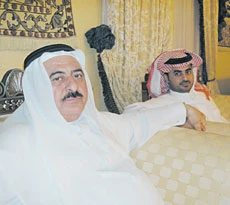
JEDDAH, 23 July 2005 — For Jeddah businessman Abdul Khaleq Saeed, the issue at the moment is Saudi Arabia’s bid to join World Trade Organization (WTO); he is very much in favor. However, this is only the latest in a long line of battles to win. His involvement in industry in Jeddah goes back to the times when anyone who needed electricity had to have a generator.
This seasoned business leader with interests in a number of fields was recently interviewed by Arab News on his views on the private sector, his investments in India as well as a number of other issues.
Like many businesses in Saudi Arabia, his flagship company, A.K. Saeed Co. for Trade & Industry Ltd., is multifaceted. There is a production unit canning Pepsi Cola products including Pepsi, Mirinda, 7-Up and other beverages; a factory — Jeddah Foam — manufacturing “Soft Dreams” mattresses, pillows and carpets; a partnership with Carnaud Metal Box Overseas Ltd; and many others besides. It also owns the Jebel Ali Container Glass Factory in Dubai, which produces bottles for all bottling companies operating under Pepsi Cola International brands. It all started as a family business with roots going back generations.
By the 1960s, A.K. Saeed and his father had concentrated on trade with the Indian Subcontinent and the Far East. So in the 1970s, when the Saudi economy began to change, the Saeeds were well placed to respond to the changes and carve a name for themselves. “We grew in 1973 when the oil prices went up from $3 per barrel to about $35-40 per barrel,” A.K. Saeed said at his palatial home located in one of Jeddah’s most fashionable districts. “Life changed completely. I remember King Fahd announcing his plans to make the Kingdom an industrial country.”
The Saeeds saw the chance to make their own significant contributions to the development of the private sector. “We immediately got the message and started building the foam factory,” A.K. Saeed said. “After that, we built the Pepsi Cola factory, and the perfume factory and then an aluminum canning factory, the glass factory and then the plastic factory. We went into industries in a big way — and it paid off.”
All these years on, A.K. Saeed is still looking at new opportunities — and for him, WTO membership is an opportunity to be grabbed. Despite the concerns of others, he sees it as a logical and necessary step toward further economic development. “We have to export. We have to import,” A.K. Saeed says. “The WTO will be good from the businessmen’s point of view. We want open markets. Today, we have around 4,000 manufacturing units, and most of them are not exporting, so if there are open markets it will be good for them.”
He says manufacturing exports are the key to future growth. “We need to export to Far East, to Europe, to everywhere — without duties.” The enthusiasm is evident. “We have to aim high, and we have to join WTO. Competition is good. It forces people to produce quality goods. What is the problem with that?” he asks.
He dismisses the concerns. “It will be great for our country,” he says. “There will be no problems. We have a lot of factories, and we export 60-70 percent of our production abroad to America, China and Japan. There is nothing to worry about.” While focusing on the potential of export markets, A.K. Saeed does not ignore the opportunities at home. “We need residential buildings,” he says. “We need 300,000 flats in the next five years for the new generation.” He also looks favorably on government moves to increase tourism in the Kingdom. “We are the leader of the Muslim world. If there is flexibility in issuing Umrah visas, nearly one to two million tourists could come to Jeddah every month,” he said. “That is what Prince Sultan ibn Salman, secretary-general of the Supreme Commission for Tourism, is doing. There is a massive need for hotels and transportation. All this will add to our economy. The investment avenues are limitless.”
A.K. Saeed’s focus is not limited, however, to what Saudi Arabia can achieve. He also sees great opportunities in the Indian Subcontinent and plans major investments in India. “India has grown with the speed of a rocket,” he said. “I hope India will be one of the biggest powers in the world in everything — economically, industrially, in science, in technology. Indians are clever people. Business is in their blood. They have opened up a lot, and there is no way they are going to go back. They can only go up. I see a lot of potential in Hyderabad, Kerala and the entire south of India. I see in them a hunger for investment. Bombay is very busy. New Delhi is very busy. But Hyderabad is the hot city. It is neat, clean and green. Let me tell you one thing, though. The government of India has to be more flexible for the people who come from abroad for investment.” A.K. Saeed is also the president of the Saudi-Indian Business Network.
He believes that countries which attract direct foreign investment are the ones that offer the best business climate. “When somebody comes to you with money, make things easy for him,” A.K. Saeed says. “He cannot wait for months for license. It should be a matter of days. Today, when you go to any country you get licenses and facilities in a few days. Take Dubai, for example. You go to Dubai, and you will get everything done the same day — license, land, labor. Everything. Flexibility and facilities are very, very important for any country in this world today.”
Looking back at his early days in Jeddah, A.K. Saeed wonders if the city’s infrastructure is up to the task of taking the Saudi economy to the next stage of growth.
“When we started our industries there was no electricity, no roads, no telephones,” A.K. Saeed said. “When we started our foam factory we had to bank on generators for electricity. We bought the generators from Zahid. Jeddah is very green these days. That was not the case in those days. Nobody imagined Jeddah would be what it is today.”
He hopes that the city’s current administration has a clear vision for the future.
“When Dr. (Muhammad Saeed) Farsy was mayor of Jeddah, the city made great strides,” A.K. Saeed said. “There was great development. After him, nothing more was done — nothing more was added to what already existed. We hope now that Dr. Adel Faqeeh is there maybe Jeddah will grow.” Dr. Faqeeh, he said, has his work cut out for him.
“There are a lot things that can be done and should be done,” A.K. Saeed said. “Traffic has become a big problem, so now we need flyovers and underpasses. We need to plan the city in a better manner. We need a few tower blocks, such as in Dubai. Dr. Faqeeh is a very shrewd businessman, and as mayor he can give Jeddah a face lift - provided he gets the support from government and the private sector.”
Surprisingly, given his achievements, A.K. Saeed is extremely cautious when asked for advice about starting a business. “My father, my grandfather, even my mother’s family, were all businesspeople,” A.K. Saeed said. “We’ve been in business for about 300 years now.” Would-be businesspeople should not be afraid to roll up their sleeves and work. That is a ground rule. “We worked very hard,” he said. “When I was young, I used to work for 18 and 20 hours a day continuously. I would sleep only for three or fours hours and would be back at work. I am very happy with all that I achieved. When you work and make money then you don’t feel tired. You don’t have any problems. But if you work and there is no money and no profit, then there is a big problem.”
The secret to success?
Experience. “People come to me to seek my advice on starting a business, and I tell them off,” A.K. Saeed says. “So many of my friends went bankrupt. You have to have experience. It is the background that counts. If somebody comes to me to seek advice about starting a business I will advise him against it. Instead I will tell him to approach a business family and be a partner with them.”