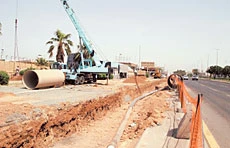
JEDDAH, 11 August 2005 — Water and Electricity Minister Abdullah Al-Hussayen has promised to end Jeddah’s sewage water problem within four years. “Once the ongoing sewage pipeline project is completed, we hope the problem would be solved once and for all,” he said.
Speaking to reporters after inspecting the sewage pipeline project in Jeddah on Tuesday, the minister said works on the project are now in progress in the northern part of the city. “Contracts will be awarded soon to implement the project in South Jeddah,” he said.
Al-Hussayen also disclosed plans to expand the city’s sewage water treatment plants, adding that their capacity would be increased to more than one million cubic meters. Water from these plants will be used for agricultural and other purposes.
The government has allocated SR7 billion for sewage water projects and SR2 billion for sewage water treatment plants. The general plan for the Jeddah sewage network is ready at the ministry, which has invited tenders for 20 sewage projects.
According to previous estimates made by experts, Jeddah required more than SR20 billion in investments for water and sewage projects.
The capacity of Al-Khamra sewage water treatment plant has been raised to 500,000 cubic meters while that of the plant at King Abdul Aziz Airport to 250,000 cubic meters.
The airport plant, which will use the latest sewage treatment technology, will treat sewage water from north Jeddah in the first phase.
Al-Hussayen downplayed reports about severe water supply shortages in various parts of Jeddah. “What happened was not disruption of supply but disorder in the distribution system,” he explained.
He said the problem would be solved within three years when Shuaiba-3 desalination plant would be ready. Contract for implementing Shuaiba-3 will be awarded soon, he said, adding that it would supply more water to Jeddah, Taif and Makkah as well as to some parts of Baha.
Jeddah Holding Company (JHC) has embarked on a major project to develop disorganized and poorly maintained residential districts in the central and southern parts of the city. According to Saleh Al-Turki, the managing director of the company, plans and studies for the new construction projects will be ready shortly. The project will include construction of sewage systems in the area.
The company is likely to play a major role in solving the city’s sewage problem as it is licensed to provide infrastructure, maintenance, operation and management services. It also specializes in sewage water treatment, water desalination, refining, drinking water distribution and operation and maintenance of water networks.
Referring to privatization of the ministry, he said it was still in the beginning stage. “We have already signed an agreement with a French company to study the network in Riyadh, and with a Swiss company to study the problem of water leakage from the network,” he added.
Similar agreements will be signed to study networks in both Jeddah and Madinah. “This will give the private sector an idea about the ministry’s services,” he added. There were reports about privatization of the Kingdom’s desalination plants.
While talking about the merger of water and electricity bills, Al-Hussayen said its experimental implementation in the Eastern Province was a success. “Now, we’ll implement it in major cities,” he added. He said the two bills would be merged all over the country starting next year.