
LIKE its TV campaign says, Malaysia is truly Asia. A tour of the country should convince anyone how the people of various ethnic groups, be they native Malays, Chinese or Indians, live in perfect harmony and interact freely. This, aside from its emergence as one of the most progressive countries in terms of economy and tourism, has been the main attraction for millions of tourists from all over the world to choose the country as a preferred destination for business, vacation or leisure.
The recent summer vacation indicated that Malaysia continues to be a favorite destination for Saudi and other Arab tourists. “The tsunami that hit some of the Far Eastern countries did not affect Malaysia. So the country continued to get tourists from the Kingdom, the rest of the Middle East-Gulf region and elsewhere in the world,” says Malaysia Tourism’s Jeddah-based regional representative Zalizam Zakaria.
Of course Kuala Lumpur, the country’s capital, remains the focal point of new Malaysia. While the city’s past is still present in the evocative British colonial buildings of the Dataran Merdeka and the midnight lamps of the Petaling Street nightmarket, that past is everywhere met with insistent reminders of the city’s present and future.
The city’s bustling streets, its shining, modern office towers, and its cosmopolitan air project the unbounded spirit of progress of Malaysia’s unhesitating leap into the future.
“To some, this spirit seems to have been gained at the loss of ancient cultural traditions, but in many ways Kuala Lumpur marks the continuation rather than the loss of Malaysia’s rich past,” another Malaysia Tourism executive emphasizes. Like Malacca, Kuala Lumpur’s commercial center is a grand meeting place for merchants and travelers from all over the world.
In the same way, the city brings together Malaysia’s past and present, its many constituent cultures, and even its remarkable natural treasures, allowing first-time visitors an invaluable opportunity to see Malaysia as a whole before setting off to explore its parts.
In the botanical and bird parks of the Lake Gardens one is treated to a first glimpse of the unsurpassed beauty and variety of Malaysia’s plants and animals. In the vibrant Central Market, music, crafts, and cultural practices from Kelantan to Sarawak can be explored and experienced. And in the National Museum, the dizzying multiplicity of Malaysia’s cultural history comes into focus.
As the entry point for most visitors and the meeting point of the country’s many attractions, Kuala Lumpur is a grand gateway to a fascinating destination.
Kuala Lumpur is situated midway along the west coast of Peninsular Malaysia, at the confluence of the Klang and Gombek rivers. It is about 35 kilometers from the coast and sits at the center of the peninsula’s extensive and modern transportation network. Kuala Lumpur is easily the largest city in the nation, possessing a population of over one and a half million people drawn from all of the country’s many ethnic groups.
Malaysia Tourism and its local representatives Zalizam Zakaria and Shamshul Mohamed Hassan are so alert about promoting tourism to their country that they spare no effort to clarify a situation.
In one of the recent instances, they were quick to communicate to Arab News their ministry’s announcement that Kuala Lumpur and its surrounding areas had once again haze-free blue skies.
“The air quality in Kuala Lumpur and its surrounding areas has improved over the weekend due to wind and rain and the Klang Valley is haze-free again,” the ministry said in a communication to Arab News. That was the time when thick smog had enveloped Kuala Lumpur, Port Klang and Kuala Selangor.
Malaysia Tourism is also well equipped with tourist information and packages. It also has a list of tours to recommend. Places recommended include Batu Cave and the suburbs. All tours are offered by Viator, a preferred partner of Geographia Travel.
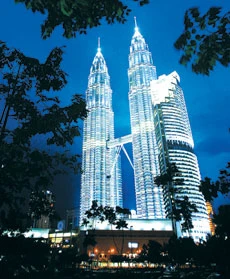
“You can end your evening tour of Kuala Lumpur with a wonderful dinner in the Seri Angkasa Revolving Restaurant on the top floor of the majestic Petronas Towers,” another tourism executive says.
“With a height of 1,453 feet, it is one of the world’s tallest buildings that rise above the skyline of Kuala Lumpur.” The towers have become the symbols of the astounding growth that has taken place all over the country over the last two decades.