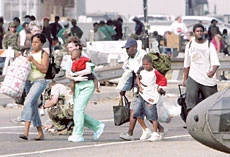
WASHINGTON, 4 September 2005 — The US National Guard finally arrived in force Friday and yesterday with scores of amphibious vehicles and Humvees going through streets to offer food, water and some semblance of order to a populace that has been stranded for more than five days following Hurricane Katrina’s vicious attack on the Gulf of Mexico coast six days ago.
Many of the troops were greeted with cheers and jeers, and cries of “Thank you, God!”
On Friday the first major relief convoy in five days made its way through high-standing dirty, muddy water to the New Orleans Convention Center where 15,000 to 20,000 desperate refugees have taken shelter.
The Guardsmen set up food and water distribution lines, dispensing the first of millions of military MREs (Meals Ready to Eat), that feed the troops in Iraq. Dozens of armed soldiers kept a cautious eye on the crowd as rescuers, law officers and even medical-evacuation helicopters reported being shot at by snipers and hoodlums.
“We have to look out for snipers, unfortunately,” Staff Sgt. Paul Hall of the Louisiana National Guard told reporters. “That’s been a big problem down here. They’re like terrorists.”
Iraq’s deputy ambassador to the United Nations Friday couldn’t resist from making the ironic comparison between the way US troops have been sent to New Orleans to put down looting and the failure in 2003 of coalition forces to halt looting in Baghdad and other Iraqi cities.
Angry questions continue as to why the military had not dropped food packets for the survivors — as was done in Afghanistan, Bosnia and in the aftermath of the Asian tsunami.
Some refugees said they found the police and National Guard, in their attempts to gain control of the Convention Center, had been as menacing and terrifying as the thugs who sporadically fired guns inside and outside the center, often setting off stampedes.
Inside the stadium, several reporters noted that lawyers already were circulating among the storm victims, promising to find compensation for them with a class-action lawsuit against city and state officials.
The death toll from the Katrina disaster remains indiscernible, but it has become increasingly apparent the body count would exceed several hundred, and fears remain that it will mount into the thousands.
The arrival of thousands of soldiers to the stricken area followed complaints from the mayor and others — themselves targets of incompetence — that the federal government had mishandled the relief effort and let people die in the streets for lack of food, water or medicine.
City officials accused the government — namely the Federal Emergency Management Agency — of incompetence.
“Get off your asses and let’s do something,” New Orleans’ Mayor C. Ray Nagin told WWL-AM Thursday night in a rambling interview in which he swore, yelled and finally burst into tears. “Excuse my French — everybody in America — but I am pissed.”
As mayor, he said he would use his business acumen to create a larger black middle class by restructuring a local economy that had too many low-wage jobs in the tourism and hospitality industry, and not enough of anything else.
But many wonder — when the city finally dries out — if there will be any tourism industry left.
There was lots of blame to pass around: FEMA Director Michael Brown blamed emergency assistance delivery problems on “the total lack of communication, the inability to hear and have good intelligence on the ground about what was actually occurring there.”
Brown and other officials argued that the disaster has made normal emergency response impossible, with impassable roads, debris-clogged streets, levee breaks, snipers, no communications, thousands of residents who didn’t evacuate and a gaggle of officials in three states trying to blindly coordinate efforts.
Pentagon and National Guard officials said the military’s response had been slowed by a combination of physical obstacles created by the storm compounded by a cumbersome bureaucratic process for sending federal forces in to assist in natural disasters.
State officials in Louisiana and Mississippi said initially they had been caught short with the absence of some 8,000 of their National Guard troops who are deployed in Iraq.
They called in Guard members from other states, but not until the storm had passed and magnitude of the emergency became clear.
The military said its first priority was delivering food and water, after which it would begin evacuating people — which could require days.
Late Friday, an explosion at a warehouse rocked a wide area of New Orleans before daybreak, jolting residents awake, lighting up the sky and sending a pillar of acrid gray smoke climbing over the city. A second large fire erupted downtown in an old retail building in an unflooded stretch of Canal Street. There were no reports of injuries, but the smoke only deepened the gloom already cast throughout the city.
Reports continued to be logged of looting throughout the city, and the police chief said even officers were breaking into stores for food and water.
New Orleans Police Superintendent Eddie Compass confirmed they had been “going in stores to feed themselves.”
Police officials acknowledged that some New Orleans officers had even turned in their badges, refusing to risk their lives by being shot at by thugs and criminals.
Daunting problems lie ahead, said Maj. Gen. Bruce Green, an air force medical officer, who expressed concern about the risk of those still in the city suffering from dehydration, stress and mosquito-borne diseases.
FEMA estimated that it could take six months to drain the city and another three months for it to dry out.
Americans throughout the US who had hoped to get away over the Labor Day weekend have had second thoughts, and many have opted to stay at home, as they’ve seen gasoline soaring well over $3 a gallon at local gas stations.
Washington area motorists continued to swarm gas stations as false rumors continued regarding impending gasoline station shutdowns throughout Maryland and Virginia
The average price of regular gas rose 26 cents a gallon in the Washington area, according to AAA Mid-Atlantic. But many stations were charging high above the $3 a gallon so lines formed at the least-expensive dealers.
In Virginia, where this correspondent lives, Gov. John Warner tried to ease consumers’ fears by announcing that flows of gasoline to the region had significantly improved though pipelines were disrupted by Hurricane Katrina.
Warner also declared a state of emergency Friday to activate the state’s anti-gouging law after gas stations were reported for charging $5.80 a gallon.
President Bush cut short his month-long August vacation by two days and returned to Washington on Wednesday to deal with the disaster, which many critics say was too late and too little to be of initial help in the critical days following the hurricane that hit New Orleans on Monday.
Recriminations increased over the weekend as critics attacked the administration for what they charged was a sluggish rescue operation beset by organization chaos in the Department of Homeland Security, which oversees FEMA, the government branch that handles disasters.