CAIRO, 8 September 2005 — Egypt held its first ever multiparty presidential election yesterday, enabling registered voters to select one of 10 candidates to head the Arab world’s most populous nation.
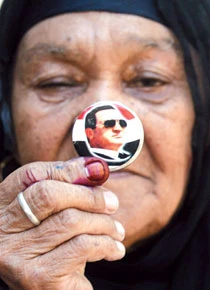
Incumbent President Hosni Mubarak, who has been in power for 24 years, is expected to win the historic poll with a landslide, though the results of the election will not be officially declared until Saturday.
Previously, under Mubarak’s rule, the presidential election was always held in the form of a referendum in which voters made a “yes” or “no” choice. No other candidate was allowed to contest the presidency.
This time, however, Mubarak is competing against nine other candidates. And although seven of them are virtually unknown to the general public, Noaman Gomaa, head of the Wafd party, and Ayman Nour of Al-Ghad (Tomorrow) party constitute a relatively serious challenge to the president.
Yesterday at 8 a.m., over 9,000 polling stations opened across the country, often with various centers located in very close proximity to each other. They remained open until 10 p.m.
Considering the fact that this is a landmark election, however, polling stations across Cairo were eerily quiet, particularly until the evening had set in. By then, voting offices started to fill up. Nevertheless voter turnout was expected to be very low. Many abstained due to a lack of interest; others because of a certainty that their favorite candidate Mubarak would win anyway; still others because of their disgust with a process and a political atmosphere which does not lend itself to change.
Registered voters were expected to present their identity and voting cards. Their names were then checked against a handwritten list in some polling stations, and against computer records in others. They then filled out their voting forms as they stood behind a curtain, and then dropped the leaflets into the ballot box out in the open.
“We didn’t find any problems with the whole process,” two law students said as they emerged from a voting station located in a police station in Dokki, one of Cairo’s more affluent areas. “In fact it was much simpler, more efficient and more respectful of the rules of transparency and freedom than we expected.” Asked who they had voted for, both said “Mubarak, of course. He’s the most prepared for the post. All the others are liars.”
Many others, however, encountered severe problems on the day. To start with, only approximately 32 million Egyptians out of over 70 million are registered to vote. Out of those, many complained that they were not able to vote yesterday, despite the fact that they have voted before. Other first-time voters found that they had not been able to complete the lengthy registration process on time, though they had not been informed of the deadline for registration.
“I have voted in two previous elections, both times in the same polling station in Helmiya,” Lotfy Mohamed Shawky, an independent newspaper proofreader, said. “This time round, when I went down to the voting office, I was told my name was not on the list — which happened to be handwritten and illegible. They sent me to another voting office in the nearby Sayyida Zainab district, where I was told I would be able to vote. When that didn’t work either, officials at the station said they’d reregister my name by next week on the voting lists. I was therefore excluded altogether from the vote. I’m very angry.”
And while government officials and the National Democratic Party (NDP) have insisted that this vote is on all accounts free and transparent, opposition parties have condemned the proceedings as unjust. In particular, Nour issued strong statements through the day condemning the election as tilted in favor of the ruling party.
Amr, an engineering student who voted for Gomaa, said that “even though the election seems unfair to me — given the fact that officials at the polling station are wearing T-shirts with photographs of Mubarak on them — I felt the need to participate if I want to initiate some change. All we need to do is take power out of the NDP’s hands. Then we’ll be able to build our own future, without the obstacles that the current regime poses.”
Meanwhile, the opposition activist movement Kefaya (Enough) held a 400-strong demonstration early in the afternoon in downtown Cairo condemning the election as fraudulent.
Prime Minister Ahmed Nazif had issued a statement warning that the government would not tolerate any demonstrations on the day of the election. Kefaya went ahead anyway. Though the presence of Central Security was relatively low around the demonstrators, as compared to any other recent protest, several activists were severely beaten and chased away by suspected NDP members later in the protest, according to eyewitnesses.
The outlawed Muslim Brotherhood — the most powerful political movement in Egypt — did not announce its support for any of the candidates. It did, however, say that it would not support any “corrupt” candidates, without specifying who it was referring to.