
JEDDAH, 12 September 2005 — With the use of computer, Internet and mobile phones increasing rapidly, Saudi Arabia has plans to shape the future growth of the telecom sector through sustained investments.
In fact, there is a move to protect the interests of computer and Internet users through a new law. “The proposed law will protect the rights of those who use them for various purposes and will be against those who commit computer and Internet crimes,” Mohammad Jameel Mulla, minister of telecommunications & information technology (IT), said yesterday.
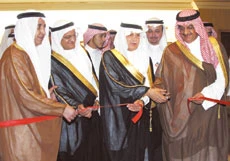
“Such a law is all the more needed, as the rate of Internet users is growing,” he said and provided a general overview of the developments in Saudi Arabia’s telecom sector, at the inauguration of the Jeddah Telecommunications & IT Conference and Exhibition at the Hilton Hotel.
Prince Abdullah ibn Fahd, assistant undersecretary at the Makkah Governorate for security affairs, inaugurated the two-day event, organized by Trade Exhibitions & Conferences Ltd. (Tradex Arabia).
Mulla said studies were under way to facilitate the entry of the third mobile service operator and the second land phone service operator in the Kingdom.
The ministry expects the number of landlines to be more than 3.8 million and that of mobile phones about 11 million by the end of the first half of 2005. “Also, Internet users are expected to reach the 2.5 million mark,” the minister said.
He said the ministry has established a center for e-government for developing the electronic gateway for government services in cooperation with other departments. It is against this background that there is a move to increase the number of computer users in both industry and at home. The Kingdom’s plan envisages the availability of one million computers within five years and thus double the number of Internet users.
“The rate of Internet users in industrialized countries is 50 percent, while in the Middle East it does not exceed five percent,” he said.
Highlighting the achievements of the telecom sector and its role in promoting economic and social developments, he said the Kingdom had made tremendous strides in the communication sector, one of its shining examples being the services offered by the Saudi Telecom Company (STC), a joint stock company. An authority also exists to monitor telecom services — Communication & Information Technology Commission (CITC).
CITC Governor Dr. Mohammed Al-Suwaiyel in his presentation spoke about regulating telecommunication & IT industry and its impact on the national economy. “Telecom and IT are a vibrant industry and a very important sector of the economy,” he said and emphasized the role of the commission in realizing its objectives. The commission has been functioning against the background of massive developments in global telecommunications. These necessarily lead to regulatory changes in the competitive and investment environment of this sector.
STC, which is keen to improve its landline services with new technology, better service and an expanded network, is among the exhibitors. STC has reduced its new installation charges to SR300 for a first line and SR200 for additional lines. This is aimed to increase the landline subscriptions. STC’s Alhatif is keen to include a host of new services including caller ID, call waiting, call forwarding, conference calls, wake-up calls, voice mail, direct incoming dialing, universal access number and virtual private network. Also, its customer calling center (907) has been improved to be fully automated to meet all subscriber needs. STC has also adopted a new strategy to reduce call tariffs locally and internationally. International calling circuits have also increased to make global communication easy.
STC’s Saudi Data is a data network service provider that offers companies a range of IT business solutions. These solutions are the “nervous system” of the company whose objective is to deliver timely and cost-efficient means of information sharing and connectivity. It addresses the demand for higher speed Internet and data services for government as well as individual and business users. Saudi Net, STC’s separate, strategic and business unit, is an Internet service provider.
Mobily, another exhibitor, is the official brand name of Etihad Etisalat, the second mobile service provider in the Kingdom. Established in accordance with a 2004 royal decree, the ownership of the company is two-fold: A Saudi ownership comprising public investors holding 20 percent of the company’s shareholding, while private investors own a 45 percent stake. The Etisalat of UAE owns the balance of 35 percent.
Bravo, the first and only specialized wireless operator offering new and powerful communications solutions in Saudi Arabia and the GCC, is showcasing push-to-do services, which include push-to-talk, and make it possible to communicate instantly with one person (one-to-one) or groups of people (one-to-many)with the simple push of a button on special integrated digital enhanced network (iDEN) enabled handsets. Push-to-view allows users to take pictures and send them instantly. Built on Motorola’s integrated digital enhanced network (iDEN) platform, Bravo provides instantaneous, cost-effective and secure communications through a range of push-to-do and digital cellular services. The system is designed to meet the needs of customers who want multiple services in a single handset, and the quality of advanced digital communications. “As a wireless telecommunications solution provider, Bravo differentiates itself by adopting a focused strategy of offering superior wireless communication services to the corporate sector,” one of its executives said. Location-based services (using the GPS functionality built-in all iDEN handsets), push-to-scan (bar code reading), push-to-swipe (credit card payment) and push-to-email are some examples of the enhanced functionalities and vertical market applications offered by Bravo.
Arabsat, the regional pioneer that has led the way for the last 30 years with a host of technological developments in broadcasting and telecommunications, is one other exhibitor. With its three regional offices in Dubai Media City, Cairo and Paris, Arabsat has announced the launch of its 4th generation satellites, described as the most powerful state- of-the art satellites covering the Arab world — Arabsat 4A toward the end of 2005 with Arabsat 4B following later.