RAMALLAH, 16 September 2005 — Palestinian President Mahmoud Abbas faced a brewing political crisis yesterday as he scrambled to quell chaos in Gaza following Israel’s withdrawal from the territory.
Lawmakers submitted a request for a no-confidence vote against Prime Minister Ahmed Qorei and his cabinet, all Abbas appointees, in protest at the failure of security forces to control lawlessness after 38 years of Israeli occupation.
Abbas can ill afford further political instability as he struggles to impose order in the Gaza Strip, which is seen as a proving ground for Palestinian aspirations of statehood.
A government shakeup could create problems for Abbas and his ruling Fatah faction in the run-up to long-delayed parliamentary elections scheduled for January.
Reflecting growing public anger over the wave of anarchy, 16 Palestinian lawmakers, including Fatah members and independents, requested a special session for a no-confidence vote that could take place as early as next week.
At least 43 lawmakers in the 86-member Palestinian Legislative Council must cast a vote of no confidence in the government to bring it down.
Abbas, a moderate who succeeded the late Yasser Arafat earlier this year, would then have to name a new cabinet. His own position is safe because he was elected by popular vote.
“In addition to holding the various factions to blame for the state of lawlessness and armed chaos, the parliament believes the government is primarily responsible for failing to act against it,” independent lawmaker Azmi Shuaibi said.
Parliamentary speaker Rawhi Fattouh said he had three days to hold consultations and set a date for the confidence vote.
Abbas has warned militants that armed chaos would not be tolerated but has not specified how he plans to combat it. Israel and Washington demand he disarm militant groups that he has coaxed into an eight-month-old cease-fire.
Islamist Show of Force
Thousands of Islamic Jihad militants marched in the former central Gaza settlement of Netzarim yesterday, firing assault rifles into the air, in the biggest show of force by gunmen defying Abbas since settlers departed last month.
Israel pulled its troops out of Gaza on Monday and handed over its former settlements in the strip to the Palestinians.
Palestinian security forces stood virtually powerless while gunmen and ordinary Gazans stormed the evacuated enclaves, smashing synagogues and looting. Police managed to impose some degree of control starting on Wednesday.
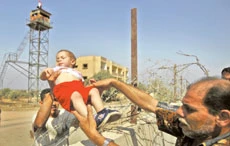
Egypt plugged some gaps in its border with Gaza yesterday, cutting off a flood of Palestinians who had been crossing freely over the past two days.
Egyptian border guards drove along their side of the line in trucks and unloaded fence posts and rolls of barbed wire at places where Palestinians had broken through the barrier.
But in the late afternoon hundreds of people were still trekking both ways through the Salaheddin Gate in the divided town of Rafah and Egyptian police had abandoned even cursory attempts to check on the travelers.
The Egyptian authorities initially said everyone should go home by Wednesday night but yesterday morning Mohamed Zorab, a 17-year-old Palestinian, said he had just got across by telling the police he was Egyptian.
He and a group of other Palestinians were waiting at a petrol station with jerry cans to fill with subsidized Egyptian fuel and take back to Gaza.
Other Palestinians were trickling back to Gaza with goats and large cardboard boxes of cigarettes for resale.
Palestinians along other parts of the border said they entered yesterday without crossing Egyptian police lines.
“The border should be left open because we are one people,” said Obeid Salama, an Egyptian of Palestinian origin with family on both sides of the line.
The Palestinian Authority said some light arms had been smuggled into Gaza amid the chaos. Israel is concerned militants may find it easier to bring in weapons without its military presence on the border.
Abbas said yesterday that he gave security forces orders to prevent further border infiltrations. “I have given them instructions to prevent violations whatever they are,” he said.
Israel is worried that militant factions, especially Hamas, which plans to challenge Fatah in the legislative elections, could seize control of the Gaza Strip.
Fattouh said another factor in the decision to seek a no-confidence vote was the killing of Moussa Arafat, a powerful ex-security chief and cousin of the late Yasser Arafat, by militants two weeks ago in the Gaza Strip.