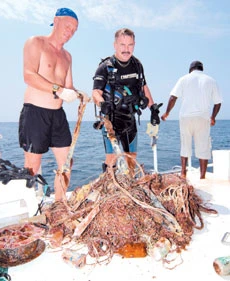
JEDDAH, 17 September 2005 — An eclectic mix of Saudi, German, Czech, British, Indian and French divers among others spent Thursday spring-cleaning three reefs off Jeddah. The trip was organized to maintain the momentum of the “Leave No Trace” campaign launched by Prince Sultan ibn Salman, secretary-general of the Saudi Commission for Tourism, last month and as a further effort by the PADI “Project Aware” campaign, which aims at raising public awareness over the marine environment.
More than 30 divers — ranging from Joel Settwarz, a pupil at the German School in Jeddah, to four-decade divers — on two boats systematically explored and cleaned two reefs several kilometers west of Jeddah and an inshore reef wall just north of Obhur Creek.
The two offshore reefs, Anna’s Reef and Coral Gardens, were comparatively clean when judged against some of the more damaged examples off the coast. The visit to these popular reefs was in part to remove garbage but also to monitor the rate at which new rubbish was being deposited.
Maggie Andriopolous, organizer of the trip for the group, sponsored by Red Sea Divers on their custom dive boats, said that although there was some new garbage, there was less of an increase. Whether this was by chance or as a result of positive action by visitors to the reef is impossible to ascertain.
“Whatever the reason,” said Andriopoulos, “there were surprisingly few drinks cans and most of the garbage we retrieved has been there for some time. I’m not sure this is an indication of improvement in reef courtesy, but it is a welcome surprise.”
Much of the retrieved trash consisted of monofilament fishing line. Of varying thicknesses, indication that both amateur and professional fishermen alike had been fishing on the reefs, many hundreds of meters of line was brought to the surface on the two 45 minute offshore dives. Much of it was hooked around hard coral outcrops — particularly “stag horn coral.” Damage to both hard and soft corals was evident where fishermen had attempted to free the lines by trying to haul them in before abandoning the attempt.
“It makes a lot of sense for divers to get involved in this sort of cleanup,” said Tim Wicker, a UK diver. “If we raise the public awareness of the state of the reefs and tend to them occasionally, we are in effect protecting them simply by being here. It combines the two best elements of the sport — challenge and conservation.”
The garbage from “Coral Gardens” — a particularly beautiful area of brilliantly colored soft corals, included two huge tires of the sort found on earth movers. The tires had caused considerable damage to the reef when they impacted the corals.
“I am loath to believe someone brought them out here to dump,” said Andriopoulos. “More likely they were used as fenders for larger boats and cut away.” However they got there and whether the motive was ignorance or arrogance, the damage was done.
The third reef, a wall off a popular local beach, was in fairly good condition. The beach has its own dive shop and visitors are made aware of the need for considerate use of the reef. The main damage — both past and present — is the deposition of silt and sand from nearby shoreline building projects. These invariably involve dumping hardcore and sand over the back-reef — the shallow area between the seaward edge of the reef and shoreline — to make building land. Southward drifting sand and suspended material had reduced visibility and covered many of the corals in a fine layer of silt. As corals rely on photosynthesis for survival, any reduction in light imperils their survival.