
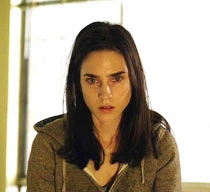
JENNIFER Connelly doesn’t lay claim to personal experience with the supernatural.
“I’ve yet to see any ghosts,” says Connelly. “I mean, lots of people are haunted, but in a more abstract way.”
Still, she bought into the ghost story in “Dark Water,” a remake of a Japanese horror-thriller that, like “The Ring” before it was directed by Hideo Nakata and based on a story by Koji Suzuki. In the American version Connelly plays Dahlia, a woman who moves into a creepy apartment building with her young daughter and is menaced by possibly paranormal overflows of yucky-looking water.
The kicker is Dahlia’s estranged husband would have her believe she’s mentally ill and weakened from the scars inflicted by an alcoholic mother, so she’s not sure how much of what she’s experiencing is real.
“I thought it was really interesting that this is a genre film, but, at the center of it, you have this woman who’s going through a divorce and custody battle and she’s having to confront the ghost of her childhood and this relationship with her mother,” says Connelly.
She also liked the fact that Brazilian director Walter Salles, who is making his Hollywood debut with the project, was known not for horror films but for South American-set dramas such as “The Motorcycle Diaries,” “Behind the Sun” and the Academy Award-nominated “Central Station.”
“There’ve been directors over the years who have made very interesting horror films — if you can call them that — who didn’t have a history of making those sorts of films, like Roman Polanski or Stanley Kubrick,” says Connelly, alluding to “Rosemary’s Baby” and “The Shining,” respectively. “I’m always a fan of putting at-first-glance disparate elements together and seeing what happens.”
Connelly, 34, is a mother of two, Son Kai, from her relationship with photographer David Dugan, was born in July 1997, and son Stellan, with husband Paul Bettany, was born in August 2003. She says her maternal experience was helpful but not necessary in playing Dahlia.
“They’re fictional characters so, of course, it’s not a prerequisite to be a mother to play a mother because you would do research and observe and do an impression,” she says. “But certainly I wasn’t going to try and pretend I’m not a mother. The fact that I’ve been raising my own children for (more than) seven years certainly informs the way I did this.”
Since the new millennium started, Connelly seems to have been drawn primarily to dark films, playing a drug addict in “Requiem for a Dream,” the lover of a tormented painter in “Pollock,” the wife of a troubled mathematician in “A Beautiful Mind” and an alcoholic lost soul in “House of Sand and Fog.”
“I don’t know that they’re all dark characters,” Connelly tells reporters in an interview at the Ritz-Carlton at Battery Park, on the southwest tip of Manhattan. “I’ve done a number of dramas. I think, for example, Alicia Nash — my character in “A Beautiful Mind” — is actually really feisty. So they’re really different characters.
Connelly, who won the Oscar for Best Supporting Actress for her work in 2001’s “A Beautiful Mind” (the film on which she met Bettany), is highly regarded as an actress. But that wasn’t always the case. Throughout her teens and early 20s the brunette was noted for a combination of beauty and stiff performances.
The New York native, reared in the Catskills and Brooklyn Heights, was encouraged to start modeling at 10. About a year later a casting director brought her to the attention of director Sergio Leone, who cast her in “Once Upon a Time in America.” Such films as “Seven Minutes in Heaven,” “Labyrinth,” “Some Girls,” “The Hot Spot,” “Career Opportunities” and “The Rocketeer” followed.
The shift in the critical appraisal of Connelly’s work occurred at the same time she pinpoints as her change in attitude about acting.
“I can see a real turning point in terms of how I work, which I put right around the time of ‘Waking the Dead,’ which I did right after my older son was born,” she says. “Because I hadn’t chosen it as a career for myself at age 11 but sort of kept working, that was where I decided I really wanted to take responsibility ... for my work and make all my own choices, and I really approached it with a new passion.”