GAZA, 18 September 2005 — The Palestinian Authority police fired in the air to disperse stone-throwing youths at the Gaza-Egypt border yesterday as forces tried to stop the chaotic flow of people across the frontier since Israel withdrew from the Gaza Strip. President Mahmoud Abbas has vowed to stop the irregular border crossings, which fueled Israeli worries that arms would be smuggled to Gaza militants following its troop withdrawal after 38 years of occupation.
Thousands of jubilant Gazans have broken through the border, formally patrolled by Israel and now under Egyptian control, to take advantage of an opportunity unknown for decades. Many went to see long-missed relatives or shop. The chaos at the border added to a growing sense of lawlessness in the Gaza Strip, seen as a testing ground for the statehood that Palestinians also want in the occupied West Bank.
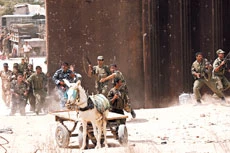
Witnesses said Palestinian forces fired bursts of gunfire in the air in at least two places on the border to disperse dozens of youths trying to cross to the Egyptian side. Four policemen were lightly injured by stones. “Palestinian and Egyptian security forces are allowing only people returning to their homes on both sides,” Palestinian Interior Ministry spokesman Tawfiq Abu Khoussa said.
Cranes lifted cement blocks to seal holes in the giant 10- to 15-foot border fence that had been knocked out by smugglers and armed factions. “We deployed today 1,500 police and national security forces. It started at 7 a.m. (0400 GMT) and it is completed now,” Abu Khoussa told AFP. Egyptian and Palestinian police were only permitting people to head back to their native soil and not allowing anyone else to pass, limiting the traffic to one section of the wall.
They checked identification cards and gave chase to anyone who tried to vault into Egypt. Egyptian Army trucks rode up and down the border to enforce the clampdown. The flow of smuggled goods brought in by the ton this week fell to a trickle as people hauled back only small quantities of items like cigarettes and gasoline. The security source said a total of 2,000 police should be deployed to the border by today. Israel ceded control of the buffer zone on the frontier to Egypt as part of its Gaza withdrawal.
But the 750 Egyptian officers who deployed there did not stop thousands of Palestinians and Egyptians from crossing through holes militants blasted in the barrier. Palestinian forces worked yesterday to plug the breaches with concrete blocks. Egyptian forces shored up the other side and blocked the path of Palestinians trying to get in. Palestinians still managed to get across the Egyptian border and due to their numbers, Egyptian and Palestinian forces subsequently made little effort to stop them.
Israeli Prime Minister Ariel Sharon said in remarks published yesterday that Israel could hinder voting in the occupied West Bank during a Palestinian legislative election in January if Hamas candidates take part. “We will make every effort not to help. I don’t think they can have elections without our help,” Sharon was quoted by The New York Times as telling journalists at a meeting in New York. Hamas is widely expected to do well at the ballot box at the expense of Abbas’ mainstream Fatah faction. Abbas has shied away from disarming Hamas by force, as Israel would like, and hopes to move it into the political mainstream and away from fighting the Jewish state — which it has sworn to destroy.
Israel has ruled out talks on Palestinian statehood in the West Bank until Abbas does crack down on militants. Palestinian officials condemned Sharon’s comments and said Israel should not obstruct internal Palestinian affairs.
Hamas delivered its own warning. “The Israeli occupation will shoulder the consequences and the responsibility for any intervention on the ground to undermine the election,” Hamas spokesman Sami Abu Zuhri said. As part of Israel’s pullout deal from Gaza, the Palestinian Authority and Egypt had agreed to police the Rafah border, which Israel had locked down over the five-year Palestinian uprising. But militant groups have defied Abbas, flouting his rule and exposing his government’s lack of power on the ground.
On Wednesday, people watched as militants from the Islamic movement Hamas detonated a section of Palestinian border fence, ignoring pleas from the Palestinian security forces. The rioting spread to the northern West Bank yesterday as Palestinians pillaged the abandoned settlement of Homesh, which Israel evacuated last month along with three other communities around Jenin, witnesses said.
With an eye to reviving the peace process, the offices of Abbas and Sharon confirmed the two men were to hold a summit on Oct. 1 or 2. It will be their first meeting since Israel completed its historic withdrawal from Gaza after a 38-year presence in the impoverished territory.
“They will discuss Israel’s next step and how to implement more of the road map,” Abbas’ spokesman Nabil Abu Rudeina told AFP. He was referring to an internationally drafted peace blueprint intended to pave the way for Palestinian statehood that has made next to no progress since its launch in 2003.