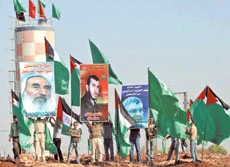
GANIM, West Bank, 22 September 2005 — Waving the flags of rival armed factions, Palestinians poured into four abandoned West Bank Jewish settlements yesterday after Israel completed their evacuation under a plan to “disengage” from conflict. Unlike the Gaza Strip, which Israel quit earlier this month, the settlements of Ganim, Kadim, Sanur and Homesh are in an area of the occupied West Bank remaining under Israeli Army control.
But the army announced the complete removal of soldiers from the enclaves on Tuesday night, leaving them accessible to Palestinians from the nearby city of Jenin. Whipping up a giant crowd in the former enclave of Kadim, local Al-Aqsa Martyrs Brigades leader Zakaria Al-Zubeidi promised that “the resistance would continue until the liberation of all occupied Palestinian territory.
“We liberated a small part of our motherland and we will not give up our weapons before the end of occupation in all the Palestinian territories,” said Zubeidi, who has escaped numerous Israeli attempts to arrest or kill him.
“Israel should withdraw from all the occupied territory and give the Palestinians the right to have their state,” Zubeidi said in a speech to dozens of followers in Ganim. Zubeidi and fellow activists fired in the air and acted out guerrilla ambushes — a reminder to Israel that a Palestinian revolt, largely in check since a cease-fire was declared in February, could soon resume.
Palestinians welcomed the Israeli withdrawals, which Prime Minister Ariel Sharon called “disengagement” from violence that erupted in 2000. But they suspect Israel plans to parlay the Gaza pullout into a permanent hold on much of the West Bank.
There are also internal challenges, with Palestinian President Mahmoud Abbas scrambling to preserve the primacy of Fatah against ascendant Islamist groups. Chief among these is Hamas, which is expected to make a strong showing in an upcoming Palestinian parliamentary election in the West Bank and Gaza.
In Sanur, Fatah loyalists took over an Ottoman-era compound that only a month ago saw fierce standoffs between die-hard young settlers and Israeli security forces, and unfurled a huge portrait of late Palestinian leader Yasser Arafat on its facade. On a telephone pole opposite, Hamas supporters waved their group’s green standard.
Meanwhile, a top aide to Sharon hinted yesterday that the Israeli premier could quit the extreme right-wing Likud party if he is forced into an early leadership contest against his archrival Benjamin Netanyahu. The Likud’s central committee is to meet from Sunday to decide whether a leadership primary should be held in November, a move which polls indicate will see Sharon dethroned by the faction he was instrumental in founding.
While Sharon has insisted he has no intention of quitting Likud, his adviser Eyal Arad indicated that such a move was a possibility as he articulated fears that the Jewish settler movement would try and wreak its revenge. “The prime minister does not want to quit the Likud, but if Likud members, at the urging of Yesha (the main settlers’ lobby), headed by Bibi (Netanyahu) who has jumped on the bandwagon, decide to throw him out of the Likud ... he apparently has no choice,” Arad told army radio.
The prime minister is desperate for any election to be held many months down the line in order for the bitterness within Likud, stirred up by his decision to pull troops and settlers out of the Gaza Strip, to die down. While he has managed to peg back Netanyahu’s lead among the 130,000 Likud members, polls still show that Sharon would likely lose if a ballot were to take place now.
Netanyahu resigned from Sharon’s Cabinet last month in protest at the pullout from Gaza that had the backing of a majority of the Israeli public as well as widespread international support. Likud members, however, never warmed to his plan, rejecting it in a partywide referendum last year — a vote which Sharon promptly ignored. His continued high popularity rating among members of the public have prompted many observers to predict Sharon will try and run for re-election outside Likud.