For the first time in Saudi Arabia’s history, Custodian of the Two Holy Mosques King Abdullah has given orders to give all citizens, including students and workers, the day off on Sept. 23 to mark the Kingdom’s National Day.
Nafeesah Alshibani, director of the History and Geography Department at the Presidency of Female Education, welcomed the decision. “Now that it is in the system, the National Day will, no doubt, stick in the students’ memory, especially now that it is an actual holiday,” she said.
Until this year the National Day was never officially observed, either by the government or the private sector.
Everybody expressed happiness that the day is being observed at schools, but one cannot but ask why did it take this long? According to Mohammad Alzahrani, principal of Jeddah Private School’s elementary section for boys, “The idea of celebrating a special date other than the two Eids was a taboo for the religious conservatives. But in the light of terrorism threats and the young age of Saudi terrorists, who were effortlessly brainwashed by their leaders just because they lacked a strong foundation of patriotism, things had to be changed. It was realized that intellectual security is becoming even more critical today than national security,” he explained.
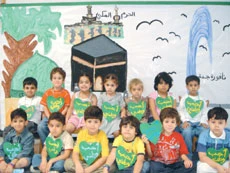
“We used to do things from time to time but we never took the National Day as a theme. However, things have changed this year and we want to make a big deal out of it,” said Nisreen Tarabzooni, principal of the pre-school section at Jeddah Private Schools, enthusiastically.
There is a nationalism curriculum that is being taught, surprisingly, only to boys, which excludes girls from their basic right as future citizens to have equal knowledge and love of their country.
Alshibani said that the Ministry of Education plans to introduce a nationalism course for female students, but could not offer a specific date.
However, she stressed Saudi schools’ obligation to inculcate a sense of nationalism. “Every young boy and girl has the right to be introduced to his or her country. And particularly on the National Day.”
But the irony is that even the nationalism curriculum, which is being taught to boys, has been criticized by many parents, educationists and teachers as being too shallow and useless.
“Frankly, it is a complete waste of time,” said Principal Alzahrani. “It starts at a very late stage, at the fourth grade of elementary school, and it lacks inspiration or motivation,” he added.
Wafaa Alharthi, mother of third grade and sixth grade boys, wants it to be canceled as a subject: “Whoever designed the national education curriculum is not an education specialist.”
Alzahrani believes that patriotism should not be taught as a curriculum subject, instead he suggests that teachers should take advantage of his or her own teaching skills and bring out the patriotism theme in different subjects. “Be it through a simple notice on the blackboard; a cartoon, or any other school activity,” he explained.
But exactly when is the right age to teach someone about his or her country?
“As early as it can be taught, the younger the better.” Alzahrani replied firmly.
Tarabzooni agreed: “A child knows very well the meaning of love and sacrifice, they already understand it but our role is to organize their stream of ideas and thoughts.”
“With a little bit of imagination it is not very difficult for a child to absorb the information as long as it is demonstrated in a simple way. Children are quick learners when the information is tangible,” she explained.
Lina Alabyadh, director of the Early Childhood Center in Alkhobar, explained that they “start with teaching the children about their schools, followed by their homes and families, and then their city. After that comes the country, its location in the world, borders, etc. Only then the child will be aware of his or her own national identity.”
Mona Alshareef, a librarian at Jeddah Private Schools, believes that storytelling can easily strengthen the national identity in children: “The school library plays a vital role in this, because stories can be very effective. Children live in Saudi Arabia but do not know their country, so we have to reflect our country’s past and present by telling them our stories; our reality; showing them our homes; how we lived; our clothes; our food and cuisine.”
When asked if it would have been better if the Ministry of Education gave all schools guidelines or a model for teaching nationalism, Alabyadh, who has an MA in early childhood education, said: “The ministry should not get involved in the details. These should be left to schools’ imagination, otherwise there will be no creativity.”
She said that teachers should involve all students in physical group activities and workshops like making the Saudi flag, drawing a giant map of the Kingdom, wearing traditional clothes and playing traditional games.
Perhaps there is no special recipe or technique on how to love your country, but nationalism should not be expressed only through football or music. Saudis have to teach this love of country to their children from birth, with every possible help from schools.
This is not a “mission impossible.” Every school, both public and private, in the Kingdom must have teaching patriotism as a priority item at the top of their agenda. It should be stressed all throughout the school year and not only on the National Day.
— Published in Arab News Saudi National Supplement (Sept. 23, 2005).