
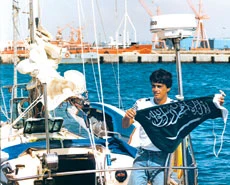
On Sept 9, 1988, Al-Sharif Jameel Adnan and Chahrazad Zaky made history when they became the first Arabs to successfully circumnavigate the globe, carrying with them the Saudi Arabian and Egyptian flags around the world, atop their nine-meter long sail boat, “Baraka-A”.
The dream to sail around the world has been with Jameel for as long as he can remember. “It’s man and the elements, and the wind blowing through your hair — nothing else. Sailing demands total concentration, a ‘feel’ for the wind, and it blows the everyday ‘cobwebs’ clean away from your mind. It’s simple, I only feel fulfilled when I am sailing,” Jameel explained.
The couple began their unforgettable adventure in Casablanca, Morocco on Nov. 10, 1986. Together they set sail across the Atlantic Ocean to Antigua and the Caribbean Sea, through the Panama Canal, into the Pacific and onward to the Galapagos Islands, the Marquesas, Tuamoto Islands, Tahiti, then onto the Cooks Islands, American Samoa, the Island of Rotuma, and Australia. The Adnans then crossed the Indian Ocean to Sri Lanka and Oman, before entering the Red Sea bound for Saudi Arabia and Egypt. The final leg of their trip took them across the Mediterranean Sea with stops at Crete and Malta before making their triumphant return to Casablanca — all the way around the world.
“Prince Faisal ibn Fahd, the then head of the Presidency of Youth Welfare called me before the circumnavigation and asked me to call him whenever we made landfall. When I did, he always had words of encouragement and congratulations. Both Chahrazad and I were saddened at news of his death, several years later,” Jameel said.
Baraka-A is a 31-foot Camper and Nicholson sailing sloop built with the circumnavigation attempt in mind. Jameel and Chahrazad spent a great deal of time in Gosport, England, working with engineers to modify the traditional design of the 31-foot sailing vessel, preparing it for the trip around the world.
“The 31-footer boats designed by Camper and Nicholson, have one large window on each side of the boat. I wanted four small windows instead. If an large wave were to knock out the large window, it would be very difficult to plug whilst in the middle of a storm, but with four smaller windows, if one breaks, it would be much easier to deal with,” Jameel explained.
Other modifications made to the boat included adding a weight system in the keel that would immediately right the boat in the event it overturned — which actually did happen once in the Pacific Ocean.
Baraka-A was also outfitted with solar panels that automatically charged the batteries and powered the boat’s electrical system.
Fitted with the latest in satellite navigation and communications equipment, Baraka-A was built at a cost of SR400,000 in 1986, paid for entirely by Jameel.
“I financed the trip from the beginning, but relied on my family for the rest of the trip,” he said.
Prior to 1986, the Adnans were living in California where Jameel was studying Business Administration at Menlo College, in Atherton.
Then one day, realizing that time was passing by and life was beginning to make his dream more difficult to achieve, he set a date.
“You cannot wait for the right time for your dream to happen. You have to decide on a time and everything will fall into place. I started preparing for the trip and just pushed forward to make it happen. Then one day, all of a sudden I found myself in the middle of the sea with my wife and it still felt like a dream, but is was now reality,” Jameel said.
“Jameel has always had a passion for the sea and a specific goal of becoming the first Arab and Muslim to sail around the world alone. For me the decision to go with him came without thinking. I certainly did not want him doing this alone. He is my husband, and I support, love and trust him with my life. I was sure that since it was both of our lives at stake, and not just Jameel’s, he would take even greater care,” Chahrazad, his wife of 30 years told Arab News.
There were several close calls during the circumnavigation that could have yielded disastrous results for the Adnans and Baraka-A.
“A Russian ship in the Caribbean was heading straight for us. When we saw how close it was to ramming us, Chahrazad said we should jump. As a last ditch effort, I got on the VHF radio and started calling ‘Mayday, Mayday, big ship, big ship, we are on a collision course’. The captain finally realized that we were there, and in the last moment steered out of the way. We were so small that tankers often didn’t see us.”
Chahrazad tells of another encounter that 50 years earlier could have resulted in equally tragic results. “Jameel and I anchored at a small island near the Marquises, where until the 1950s, the inhabitants used to eat visitors to the island. The man we spoke with there said that the brain always went to the head of the tribe because it is the tastiest part of the human body. We decided to leave immediately, just in case.”
Other experiences, the voyaging couple found inspiring.
“On Christmas Island, we moored overnight awaiting clearance to enter. Just before sunrise, we started to hear the Muslim call to prayers. It was beautiful, yet so strange and unexpected. It had been so long since we had heard a muezzin. We simply had no idea that there were Muslims there,” Chahrazad said.
When the couple arrived in Jeddah with just the Mediterranean leg of the circumnavigation ahead of them, the Presidency of Youth Welfare, family members, journalists, and dozens of others met Baraka-A. The Adnans were presented with commemorative plaques from the Presidency, Saudi Arabian Airlines, Mobil Oil and many others.
When Baraka-A arrived in Suez, Egypt, Mayor Tahsin Shannan, dozens of children dancers, television, print and radio journalists, and a band welcomed Chahrazad and Jameel. The Adnans ended up spending more time in Suez than they had intended, when Jameel suffered the most serious injury to befall him throughout the entire circumnavigation that had already brought them more than three-quarters of the way around the globe.
In February of 1987, along the road from Suez to Cairo one night, a driver coming out of the desert crashed into Jameel’s car. He suffered a broken arm and nose. The fracture in his right arm was so serious that he ended up having metal rods inserted into his elbow, where they still remain 18 years later.
After several weeks recuperating, Jameel with Chahrazad said goodbye to friends and family drove back down to Suez, got onto Baraka-A and headed back out to sea.
In September, a few days before the completion of the circumnavigation, Jameel was surprised by a telephone call from Prince Sultan ibn Salman, the Saudi Minister of Tourism and the only Saudi to have circled the globe from space.
Media reports of the conversation between the two circumnavigators stated that Prince Sultan, “congratulated Al-Sharif Jameel Adnan on his and Chahrazad’s achievement, that honored Saudi Arabia by flying its flag and the creed, ‘There is no God but Allah, and Mohammed is his Prophet’, around the world.”
Shortly after completing the circumnavigation, Jameel and Sherry returned to Jeddah, where Jameel opened ‘The Arab Circumnavigator Diving Center’, where it still remains today near the Tahlia Street Danube. The Arab Circumnavigator, a PADI five-star facility, has certified over 1500 scuba divers since opening in 1989.
Together the couple spent many years in the Kingdom, with Baraka-A moored in Obhur, not far away. Jameel ran the dive center and operated two diving boats, but when Chahrazad’s now booming furniture and interior decorating business required that she move to Egypt, Jameel went with her.
Today, they both live in Cairo, where Jameel and Chahrazad have again gone arm in arm into another venture. Together the couple bought a ten-acre patch of dry desert, dug a well and began growing mangoes. Today, the farm has over 1,500 mango trees, which produce a crop that is marketed throughout Egypt as, “Chahrazad’s and Jameel’s”. On the land, they have built a small, one bedroom house.
“Sitting here among nature, with nothing but the sound of trees and birds around, reminds us both of the days when we sat on our small boat and listened to the sounds of the seagulls and the waves,” Jameel told Arab News.
Though the oceans of the world are still in their hearts, 17 years later Jameel and Chahrazad remain on dry land. “Sailing has always been a passion for me, and one day I hope to return to it, maybe even professionally. The new dream, is to represent my country in an around-the-world oceanic races,” Jameel said.
Baraka-A has since been sold to Sheikh Talal Zahid, who is currently making plans to display the boat in a museum that will remind young Saudis, that several years ago, a Saudi man and his Egyptian wife, became the first Muslims, Arabs, and Saudis to successfully sail around the world.
— Published in Arab News Saudi National Supplement (Sept. 23, 2005).

