
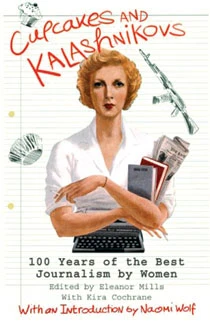
CAN your life be changed by reading about someone else’s slovenly laundry basket and their talent for holding a bottle of varnish between two fingers while painting their nails on the Tube? If the journalist is Katharine Whitehorn, then, yes — even the mundane things of life, if described with sufficient wit and charm, can prompt a moment of revelation. I can still recall the excitement of reading Whitehorn on “Sluts” during an English class at my convent school in 1974. Partly as a diversion from the usual Shakespeare, Jane Austen and Romantic poets, but also to explore other forms of writing, our teacher handed out copies of Whitehorn’s Observer piece for us to analyze. Vivid and funny, “Sluts” was already 11 years old then, but it still read as though Whitehorn had penned it the previous week. From then on I not only devoured everything Whitehorn wrote, but also I knew I had to be a journalist. It might also have been a moment of premonition, for after encountering “Sluts” again in this collection of women’s journalism, I find that Whitehorn’s descriptions of sluttish behavior — being late, losing things, running out of clean clothes and having to employ cleaners to keep life in order — have all come horribly true.
One of the pleasures of this anthology is rediscovering gems like this which are as good on a second or third reading as they were first time around. Erica Jong on the mystery of the Clintons’ marriage, and why they are utterly conventional rather than revolutionary; Marie Colvin on the paradox that was Yasser Arafat; Gitta Sereny on the pity and the horror of the killing of Jamie Bulger: they are all insightful, intelligent and well worth reading again.
Other unforgettable pieces, and new to me, were Martha Gellhorn’s account of Dachau and Susan Sontag’s brilliant exploration of photography, among many others. This book is worth buying for these two alone.
Yet it has to be said that the volume as a whole just doesn’t hang together. Eleanor Mills’s foreword fails to provide a convincing definition of women’s journalism. The days of the women’s page ghetto, when writers like Whitehorn and another grande dame contributor, Mary Stott, would write only on lipstick and breastfeeding, are gone. This anthology’s greatest pieces are the reportage, from the likes of Gellhorn and her heirs — Colvin, or Julie Flint, also included in this volume. These are just great reporters, telling us what they see, on the frontline of war. That’s what distinguishes them, not their gender. They also make some of the rest of the contents about mundane aspects of life seem, well, mundane.
There are some extraordinarily irritating aspects to this collection. It consists of American and British writers. But if writing in English is the common denominator, why not Canadian, Australian, South African writers? For some reason, the most radical writing in the book tends to concern the underbelly of American society — and revelatory it is too, but similar pieces about Britain have been ignored. Also annoying is the blatantly disproportionate number of pieces from the Sunday Times, which employs the editor of the volume. And frankly, some of that paper’s pieces just won’t do: Sarah Baxter’s account of 9/11, which focuses mostly on her toddler’s reaction to the events of the day, is tedious, and Eleanor Mills’s own account of Benazir Bhutto is merely competent. Surely editors of anthologies of the “best” of anything should have the humility to exclude their own work.
Then there is the problem of what has been left out. Any reader or journalist will have particular favorites they would want included here, but there are some omissions that are, frankly, bizarre. For a book which purports to record life for women in the past 100 years, it seems incredible that not one piece concerns either of the two women who have been most dominant in British society in that time: the Queen and Margaret Thatcher (fortunately, one of the most illuminating pieces ever written on Diana, by Camille Paglia, is included here). And not to include a single piece by Polly Toynbee, the leading female social commentator of the last 20 years, is absurd.
That said, any sixth-former considering a career in journalism would do far better to read this volume than to apply for a place on one of the myriad media studies courses which have been set up at universities in recent years. There are some exceptional writers here, writing exceptional first drafts of history.