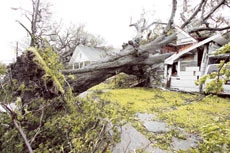
WASHINGTON, 25 September 2005 — Hurricane Rita hit America’s Gulf coast early yesterday, lashing Texas and Louisiana with driving rain but sparing the flood-prone cities of Houston and Galveston from a direct hit. “It looks like the Houston and Galveston area has really lucked out,” said Max Mayfield, director of the National Hurricane Center in Miami, Florida.
But the hurricane smashed windows, sparked fires and knocked power out to more than 1 million customers. Local officials of evacuated towns and cities urged residents to remain away until downed live electrical lines had been repaired.
Rita made landfall at 3:30 a.m. ET as a Category 3 storm on the Texas-Louisiana border. Within four hours it had weakened to a Category 2 storm, and as it moved further inland, it weakened to a tropical storm with maximum sustained winds of 120 km per hour.
Asked how Rita compared with the earlier devastating hit of Hurricane Katrina, Mayfield said: “It’s not as powerful, not as large and it did not hit as populated an area.”
About 3 million people were forced to evacuate in a chaotic exodus along a 800-km stretch of the Texas-Louisiana coast ahead of the storm, turning major cities into ghost towns.
Even before it arrived, Rita wreaked havoc with a storm surge and heavy rain. The hurricane battered the oil-refining towns of Beaumont and Port Arthur, Texas, and Lake Charles, La. Nearly all of the 70,000 residents evacuated Lake Charles, home to the nation’s 12th-largest seaport and refineries run by ConocoPhillips, ExxonMobil, Citgo and Shell.
Rita threatened dozens of refineries and chemical plants along the Texas and Louisiana Gulf coast that represent a quarter of the nation’s oil-refining capacity. The possibility of damage to pipelines and refineries in Texas added to concern over the tumultuous depletion of gasoline supplies in parts of the state.
Offshore US crude oil production in the Gulf of Mexico was totally shut with natural gas output also lower, the US Minerals Management Service said in its daily report logging the impact of Hurricane Rita and the prior Hurricane Katrina.
MMS said the percentage of oil output shut was 100 percent, up from 99.125 percent on Friday. The normal daily oil output from Gulf of Mexico operations is 1.5 million barrels per day.
Environmentalists warned of the risk of a toxic spill, and business analysts said Rita could cause already-high gasoline prices to rise to as much as $4 a gallon.
The storm’s impact on the national economy will depend on how quickly the evacuated energy facilities can resume production, and how energy prices are affected and how consumers and businesses react, analysts told reporters.
Rita’s heaviest rains — up to 4 inches an hour — fell in Lake Charles, La. National Weather Service meteorologist Patrick Omundson said the town had 8 inches of rain more than two hours before the storm’s landfall.
The storm surge from Rita caused havoc in New Orleans, cascading over the city’s patched levees and causing new flooding just days after already-devastated neighborhoods had been pumped dry. Crews began work to plug levees and stop water from pouring into some of New Orleans’ hardest-hit neighborhoods, and dozens of people were rescued.
Engineers said they needed at least two days to pump water from the most heavily flooded neighborhoods after they plug a series of levee breaches. “The surge got higher than we expected in the canal,” said Dan Hitchings, an engineer overseeing recovery operations for the Army Corps of Engineers. “It’s still spilling in there this morning.”
The corps planned to drop sand bags and boulders into several large gaps that appeared Friday in a part of the Industrial Canal levee that had been patched after Hurricane Katrina.
The Pentagon said it was sending about 500 active-duty soldiers to Louisiana and five mortuary teams to Texas to deal with the hurricane. Troops from the 82nd Airborne were heading to Lafayette, Louisiana, about 215 km west of New Orleans, to help with search-and-rescue efforts, said unit commander Maj. Gen. Bill Caldwell. He said about 3,200 of his soldiers would be prepared to go to Lafayette by today, if needed.
As a precaution, the US Northern Command redirected mortuary teams from New Orleans to Fort Sam Houston in San Antonio, said spokeswoman Air Force Lt. Jody Vazquez. Five other teams were put on alert to support task forces responding to Rita and Katrina.