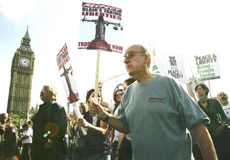
LONDON, 25 September 2005 — Over 100,000 protesters took to the streets of central London yesterday in yet another demonstration against the war in Iraq. The route not surprisingly took in Whitehall, Parliament Square, along Piccadilly before reaching Hyde Park, with a motley of campaigners shouting “Down with Downing Street, “ and “Stop the bombings” as they passed No 10 Downing Street.
Parliament Square and the West End was virtually at a standstill as protestors gathered to give Prime Minister Tony Blair an unequivocal message on the eve of the Labour Party’s annual conference in Brighton.
The march coincided with a call yesterday morning from the opposition Liberal Democrats urging Prime Minister Tony Blair to immediately start negotiations with the Iraqi government for a phased withdrawal of British troops, to be replaced by a UN peacekeeping force comprised mainly of soldiers from the Organization of Islamic Conference (OIC) countries.
The raid by British soldiers on a jail in Basra ostensibly to free two colleagues who were detained by the local police and allegedly on the verge of being handed over two local militia; and yesterday’s reported arrest warrant issued by an Iraqi judge against the two soldiers, has once again focused opposition to British involvement in the occupation in Iraq.
The protest march organized by Stop The War Coalition, the 12th anti-war march since the invasion of Iraq two years ago, attracted politicians and campaigners from all sides of the political spectrum and relatives of those British soldiers killed in action in Iraq.
Opposition leaders such as Charles Kennedy of the Liberal Democrats, who have opposed the war in Iraq from the onset, warned that Prime Minister Blair was living “in denial” and his pride and “blind support” for President George Bush are costing lives in Iraq.
Kennedy in his closing speech to the Lib Dem conference in Blackpool on Friday said the presence of British troops in Iraq was now part of the problem. And he claimed the “war on terror” had increased the threat of terrorism.
“You cannot move on, when the prime minister remains in denial,” Kennedy chided Blair. “You can’t move on when people are dying every day. And you cannot move on when our British troops are still in the firing line. After this week’s events in Basra we cannot sustain the myth that Iraqis see coalition troops as liberators. What they see is an occupation. The prime minister’s pride should not get in the way of finding a solution for the people of Iraq. His blind support for George Bush is continuing to cost lives — Iraqi citizens and coalition soldiers. It’s time he laid out before Parliament a proper, structured exit strategy for the phased withdrawal of British forces from Iraq.”
Kennedy said British troops had “served with distinction, courage and great skill. Please listen, as you didn’t before, to millions of people in our country, who are asking louder and louder as every day goes by — ‘when can our troops go home?’
The so-called war on terror, he added, has been so badly implemented that it has actually boosted the terror threat not diminished it.
Indeed, relatives of soldiers killed in the conflict, had a clear and present message for Blair. Sue Smith from Tamworth in Staffordshire, whose son Phillip Hewett died in July when a roadside bomb exploded under his vehicle near Basra, delivered a letter to the prime minister urging him to pull British troops out of Iraq and stressing: “I am sitting writing this letter hoping that you will understand how we feel, but I know that you don’t.”
She was joined by Reg Keys, whose son Tom was one of six Royal Military Policemen killed in June 2003, and Peter Brierley, whose son Shaun died in Kuwait in April of that year. British soldier Lance-Corporal George Solomou, who refused his call-up to serve in Iraq, turned up “to show my solidarity. The British people are increasingly realizing that they have been told more and more lies about the war.”
In contrast to the anti-war coalition, the main Conservative Opposition warned the prime minister that there must be a real attempt to confront militia in Iraq because the current UK strategy is not working.
Tory leader Michael Howard said pulling UK troops out of Iraq could be disastrous and make the country a centre for world terrorism.
In addition to London, opponents of the war in Iraq rallied by the thousands yesterday to demand the return of US troops, staging a day of protest, song and remembrance of the dead in marches through Washington and other cities in the US.
More than 2,000 people gathered on the Ellipse hours before the showcase demonstration past the White House, the first wave of what organizers said would be the largest Washington rally since the war began.
President Bush himself was out of town, monitoring hurricane recovery efforts from Colorado and Texas.
“We have to get involved,” said Erika McCroskey, 27, who came from Des Moines, Iowa, with her younger sister and mother for her first demonstration, traveling in just one of the buses that poured into the capital from far-flung places.
“Bush Lied, Thousands Died,” said one sign. “End the Occupation,” said another.
While united against the war, political beliefs varied in the Washington crowd. Paul Rutherford, 60, of Vandalia, Mich., said he is a Republican who supported Bush in the last election and still does — except for the war.
“President Bush needs to admit he made a mistake in the war and bring the troops home, and let’s move on,” he said. His wife, Judy, 58, called the removal of Saddam Hussein “a noble mission” but said US troops should have left when claims that Iraq possessed weapons of mass destruction proved unfounded.
“We found that there were none and yet we still stay there and innocent people are dying daily,” she said.
Arthur Pollock, 47, of Cecil County, Md., said he was against the war from the beginning. He wants the soldiers out, but not all at once.
“They’ve got to leave slowly,” said Pollock, attending his first protest. “It will be utter chaos in that country if we pull them out all at once.” Rallies were planned, too, in Los Angeles, San Francisco, Seattle, Florence, Rome, Paris and Madrid.
In a hitch for some coming to the protest, 13 Amtrak trains running between New York and Washington were delayed for up to three hours yesterday morning for repair of overhead electrical lines. Protest organizers said that held up thousands coming to the rally.
“We believe we are at a tipping point whereby the anti-war sentiment has now become the majority sentiment,” said Brian Becker, national coordinator for ANSWER, one of the main anti-war organizers.
Cindy Sheehan, the California mother who drew thousands of demonstrators to her 26-day vigil outside President Bush’s Texas ranch last month, joined the protest. Sheehan’s 24-year-old son, Casey, was killed in an ambush in Sadr City, Iraq, last year.
Supporters of President Bush’s policy in Iraq assembled in smaller numbers to get their voice heard in the day’s anti-war din.
Gary Qualls, 48, of Temple, Texas, whose Marine reservist son, Louis, died last year in the insurgent stronghold of Fallujah, spoke in support of continued US involvement.
“If you bring them home now, who’s going to be responsible for all the atrocities that are fixing to happen over there?” he asked. “Cindy Sheehan?
The protest route runs to the front of the White House, down to the Justice Department and then back to the Washington Monument, site of an 11-hour concert and rally featuring folk singer Joan Baez and stretching well into the night. Sheehan and other mothers against the war held a small rally near the Washington Monument on Friday. They spoke just a few feet from 1,000 white wooden crosses tucked into the grass to symbolize the more than 1,900 members of the US armed forces who have died since the beginning of the war in March 2003. At a rally at the US Navy Memorial put on by Protest Warrior and other groups supporting Bush’s policy, demonstrators denounced Sheehan as a mother exploiting her son’s death. “If I were to die in Iraq, I wouldn’t want my parents to be like Cindy Sheehan,” said Army National Guard Spc. Julie McManus, 20, of Drexel Hill, Pa., who was among more than 100 people holding signs. “I’d be ashamed of them.”
McManus said she drove to Washington with her boyfriend; she wore a white tank top with the words “American Solider” in black marker.
— Additional input from agencies