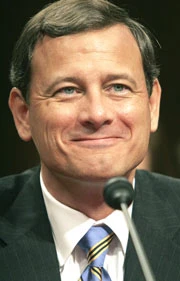
WASHINGTON, 30 September 2005 — John Roberts was sworn in as the 17th chief justice of the United States yesterday, taking his oath at a White House ceremony attended by President Bush and other justices of the Supreme Court.
Bush said it was “a very meaningful event in the life of our nation” — almost 19 years to the day since the late Chief Justice William Rehnquist took his oath in the same room at the White House, the East Room.
The 50-year-old Roberts was sworn in a little more than three hours after he was confirmed by the Senate on a vote of 78-22. The oath was delivered by Justice John Paul Stevens, the court’s senior member and acting chief justice since Rehnquist’s death early this month.
“The Senate has confirmed a man with an astute mind and kind heart,” Bush said. “All Americans can be confident that the 17th chief justice of the United States will be prudent in exercising judicial power, firm in defending judicial independence and above all a faithful guardian of the Constitution.”
Roberts spoke briefly, saying that the bipartisan vote for his nomination was “confirmation of what is for me is a bedrock principle, that judging is different from politics.”
Roberts replaces William Rehnquist, who died on Sept. 3 after being the court’s conservative anchor for 33 years.
At 50, Roberts is the youngest chief justice in 200 years and could well hold the lifetime post for decades.
Before becoming a federal judge, Roberts was one of the nation’s best appellate lawyers. Roberts served as legal advisor in the Reagan and George H.W. Bush administration.
By modern standards, Roberts’s confirmation process went smoothly. A number of Democrats opposed him largely on the basis of memos he produced while an attorney in the Republican administrations of Reagan and George H.W. Bush that caused them to question his positions on civil rights and privacy issues, including the right to abortion.
“I hope I am proved wrong about John Roberts,” said Sen. Edward Kennedy, D-Mass., the Senate’s longtime liberal conscience. “I have been proved wrong before on my confirmation votes. I regret my vote to confirm Justice Scalia, even though he, too, like Judge Roberts, was a nice person and a smart Harvard lawyer.”
President Bush is expected to soon name a second Supreme Court nominee, who is likely to face a tougher confirmation fight since the court’s ideological balance will be at stake.
The next nominee to be approved would replace retiring Justice Sandra Day O’Connor, who has often been the swing vote on the nine-member court.
— With input from the Associated Press