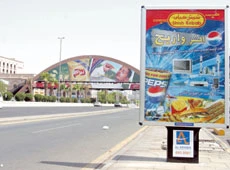
JEDDAH, 1 October 2005 — Advertising is especially designed to catch your attention. Some residents of cosmopolitan Jeddah, which is rife with billboards, say it’s doing too good a job and blame traffic accidents on motorists who have been mesmerized by lights and moving objects other than traffic lights and moving cars. Some complain that billboards instead of being a sight for sore eyes are eyesores that clutter the city with a sort of visual pollution.
Arab News recently took to the streets of Jeddah to get a look at this issue — of course we remembered to park the car first.
“I’ve been involved in three accidents in which cars ran into me from the rear,” said Sudanese expatriate Muhammad Mustapha. “Two of the accidents were caused by drivers trying to read billboard advertising.”
Some residents said the government should take it as a sign of a problem.
“I don’t believe that traffic or city officials want to reduce the number of accidents,” said Saleem Sultan, a Saudi government employee. “Looking at the street, I see all kinds of distractions that cause many accidents.”
Sultan said enough is enough. “I think that advertising thing is running out of control, and it needs to be regulated,” Sultan said. “I can’t believe that there are TVs advertising various products and services on main roads and at intersections. What will happen when drivers look at them instead of the road? Our pedestrian bridges look as if they are about to fall down because of all the advertising attached to them.”
Sultan said he recently witnessed an accident at the intersection of Tahlia Street and Prince Majed Street. The accident was caused by a motorist who jumped the red light without knowing it. He was busy watching the advertising on the big-screen.
“Thank God, no one died in that accident, but why don’t we do something to stop this from happening?”
People from the advertising community say there are other factors to consider.
“What they’re saying is not the whole story,” said Ahmad Mukhtar, who works in an advertising agency. “For example, look at Times Square in New York. It’s full of signs, billboards and live TV advertising, but accidents are very uncommon there. We need to investigate why that is so. Are people there doing something that we are not doing here?”
Mukhtar got a little sore over the eyesore issue. “It’s not fair to put all the blame on advertising agencies for destroying the beauty of Jeddah or linking advertising to the increase in accidents,” he said. “I agree that putting TV advertising at a main intersection is wrong. TV advertising should be in parks and entertainment areas where there are no vehicles. I also think that we should put much of the blame for traffic accidents on people who talk on their mobiles when they should be concentrating on their driving.”
One motorist who saw two spinning propellers on a billboard said they contributed to his own head spinning a little later.
“I remember driving on Madinah Road and on an advertising board, there was a plane with two moving propellers. It was a great idea, and it certainly caught people’s attention,” said motorist Murtada Ahmad. “The next thing I knew, I woke up in an ambulance because I had been in an accident in which I ran into the back of a truck. I had been looking at the sign instead of watching the road. Many people are easily distracted, and they are the ones who get into accidents.”
Of course, as a reader of Arab News you can enjoy our advertising in complete safety — provided you don’t try to read it while you’re driving.