JEDDAH, 3 October 2005 — Saudi Arabia yesterday called for a meeting of all Iraqi factions under Arab League auspices to promote consensus and unity on the draft constitution.
The meeting would be aimed at “achieving a broad national consensus on the constitution and guaranteeing the participation of all Iraqi groups in the political process,” Foreign Minister Prince Saud Al-Faisal said.
Addressing a meeting of an Arab committee on Iraq here, Prince Saud said Arab League Secretary-General Amr Moussa would visit Iraq to consult Iraqis on the matter.
“The main purpose of this meeting is to help our brethren in Iraq to overcome the current situation without going against their wish,” Prince Saud said in his keynote address.
A draft constitution which will be put to a referendum on Oct. 15 is opposed by Iraq’s Sunni Arabs, who held the reins of power under Saddam Hussein but feel increasingly marginalized.
Rebels waging an anti-US insurgency in Iraq have called for a boycott of the referendum and threatened to kill anyone taking part, while most Sunni organizations have urged a “no” vote, mainly because they distrust federal provisions in the draft.
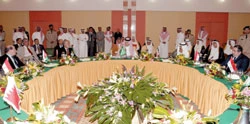
The eight-member committee met here to draw up a joint strategy on violence-ravaged Iraq, including the possibility of sending observers to monitor the referendum and national elections in December.
The ministerial committee on Iraq was created in September by the Arab League and groups Bahrain, Algeria, Egypt, Iraq, Jordan, Kuwait, Saudi Arabia and Syria.
All members were represented by their foreign ministers except Algeria, which sent presidential envoy Abdelaziz Belkhadem.
In his opening remarks, Prince Saud reiterated concerns he recently expressed about the potential partition of Iraq along sectarian lines. Calling for the preservation of Iraq’s unity and Arab identity, the prince said the “particularity” of the Kurdish population had “long been recognized” in Iraq.
“But this unique particularity cannot be applied to other Iraqi regions” if the country’s unity is to be preserved, he said, apparently alluding to fears that majority Shiites would create their own state in southern Iraq.
Last week, the Saudi foreign minister had voiced concern at purported meddling by Shiite-dominated Iran in Iraq and warned that the country’s partition into Kurdish, Sunni and Shiite states would “bring other countries in the region into the conflict.”
Iraqi Foreign Minister Hoshyar Zebari, who held talks with Prince Saud earlier in the day, urged the Arab ministers to discuss what he called “ideas (he has presented) to set up practical steps which can help boost morale on the domestic Iraqi scene.”
Iraq, “which has been afflicted by the woes of terrorism, aspires to (see) its friends and brethren standing by it at this delicate stage,” he said.
In his speech, Prince Saud said that Saudi Arabia was following developments in Iraq with great concern. “The country is going through a very sensitive stage which demands that we make our efforts together in a very transparent manner,” he told the meeting.
“Our aim is to see an independent and unified Iraq that enjoys security and stability and lives peacefully with its neighbors,” Prince Saud said and urged everyone to stick to the principle of noninterference in Iraqi affairs.
The Saudi minister expressed his concern over growing sectarianism on the Iraqi scene, saying it contradicted with the concept of Iraq’s unity. He called upon the Iraqis to give priority to national interests over sectarian interests.
“We understand that Iraq’s relations with neighboring countries has gone through many obstacles and a lot of pressure. There were sensitive times. But we have to work hard to get over the past,” he said.
Prince Saud warned that any outside interference could lead to a bigger regional conflict. “The neighbors of Iraq should understand that history would never forgive those who used the tragedy of Iraq to serve their vested interests,” he said.
“The growing fear of a civil war breaking up Iraq is not a dream or nonsense, it is something we are beginning to see day by day,” he said and blasted terrorist operations in the country, adding that they would only lead to destruction and chaos.
Prince Saud said that the need for putting a strategy with different dimensions and levels to help Iraq out of this situation has become a must now.
“Therefore the efforts has to be doubled and a fast move is needed, there has to be a new vision in dealing with the Iraqi crises, the time has come to end the absence of the Arab initiatives in the Iraqi situation” said the minister, who stated that the situation is very dangerous and demands a strong, fast, practical Arab move.