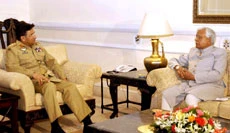
KARACHI, 6 October 2005 — In a significant development, Indian External Affairs Minister Natwar Singh yesterday announced that the Indian Consulate will be reopened in the port city by January 2006 after a break of about 12 years, sources said.
Natwar told reporters here that he had asked the consul to finish the renovation of India House by Dec. 31. “We will be giving visas from January and the Pakistani Consulate in Bombay will also be functioning by that time,” added Natwar, who was in Pakistan for peace talks and returned home yesterday.
The consulates in Karachi and Bombay were shut in 1994 amid a series of disputes including claims by then Pakistani Premier Benazir Bhutto that the Indian secret service was abetting terrorism.
The rivals agreed in July 2004 to reopen both consulates, as part of a wider peace process launched earlier the same year and aimed at ending nearly six decades of hostilities.
The consulates in the two port cities will make travel easier for members of families split during the subcontinent’s partition in 1947, who can currently only seek visas at embassies in New Delhi and Islamabad.
India is at present issuing 10,500 visas a month to Pakistanis and is prepared to do much more, Indian ambassador Shivshankar Menon said.
Menon also told Pakistani businessmen, in response to a question, that India allowed Pakistanis to visit 16 Indian cities. ‘We are ready to give more visas,’ he said.
Natwar said that the opening of the consulate would coincide with the re-opening of a rail link between southern Pakistan and Western India, which was cut off after the 1965 war between the two countries.
“We are looking forward to opening Khokrapar-Munabao railway link between Sindh and Western India,” he said.
“The Khokhrapar-Munabao rail will be opened within few weeks,” Natwar said He was talking to a delegation of Muttahida Qaumi Movement (MQM) here yesterday.
Leaders of the Pakistan People’s Party (PPP) and the MQM yesterday called on Natwar and expressed support to growing India-Pakistan relations. The MQM team consisted of senior leaders including Muhammed Farooq Sattar, leader of its parliamentary group, Anwar Alam, Shakeel Umer, Waseem Aftab, Sardar Ahmed, Nisar Panwar, Bilquees Mukhtar, Hyder Abbas Rizvi, Faisal Sabzwari and M.A. Jalil.
The MQM, now a member of Pakistan’s federal as well as Sindh governments, represents the interests of the Urdu-speaking people who migrated to Pakistan following the partition of India in 1947.
The PPP delegation included Makhdoom Amin Faheem and Nabeel Gabol, both members of parliament, and Syed Qaim Ali Shah and Nisar Ahmad Khuhro.
On Monday India and Pakistan signed deals to notify each other in advance of ballistic missile tests and to set up a hotline between their coastguards as Natwar held talks with his Pakistani counterpart Khurshid Mahmud Kasuri.
They agreed Tuesday to find a “common understanding” by January 2006 on the issue of the Siachen glacier in Kashmir, dubbed the world’s highest battlefield, where both sides have stationed thousands of troops.