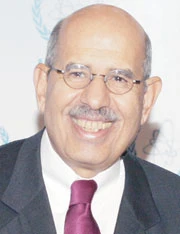
OSLO, Norway, 8 October 2005 — Mohamed El-Baradei and his International Atomic Energy Agency won the 2005 Nobel Peace Prize yesterday, strengthening his position in a job he nearly lost because of a dispute with the US over Iraq and Iran. Baradei is the fourth Egyptian to win a Nobel. Ahmed Zewail won the chemistry prize in 1999; Naguib Mahfouz won the literature prize in 1988; and the late President Anwar Sadat won the peace prize in 1979.
In announcing the winners, the Nobel Committee recognized Baradei and his team “for their efforts to prevent nuclear energy from being used for military purposes and to ensure that nuclear energy for peaceful purposes is used in the safest possible way.”
The Bush administration has bristled at Baradei’s position on the nuclear threat posed by Iran and Iraq, and unsuccessfully lobbied earlier this year to block his appointment to another four-year term.
Yesterday’s Nobel endorsement was viewed as strong vindication for the Egyptian diplomat, who favors diplomacy over confrontation in his work to curb nuclear proliferation.
“The award sends a very strong message: ‘Keep doing what you are doing,”’ Baradei said. “We continue to believe that in all of our activities, we have to be impartial, objective and work with integrity.”
Avoiding criticism of the United States, Baradei suggested that winning the prestigious award vindicated his methods — diplomacy over confrontation.
“I don’t see it as a critique of the US,” he said of the Nobel Peace Prize in comments to Associated Press Television News and two other TV outlets. “We had a disagreement before the Iraq War — honest disagreement. We could have been wrong; they could have been right.” The decision also was a signal “going to the Arab world, going to the Western world that we ... have a lot in common and we need to work together to survive,” Baradei said.
And he suggested that the dispute with Washington was over, saying US Secretary of State Condoleezza Rice phoned her congratulations and “wished me well.”
In Washington, Rice reaffirmed that the Bush administration is “committed to working with the IAEA to prevent the spread of nuclear weapons technology.”
German Chancellor Gerhard Schroeder, a critic of the US invasion that toppled Saddam, praised Baradei’s “courageous stand for an objective view of the situation in the run-up to the Iraq war.”
UN Secretary-General Kofi Annan said he hoped the award would bring greater appreciation of the agency’s work.
In Tehran, a top Iranian official who asked not to be named, said, “Since the start of the crisis, Mohamed Baradei always resisted US pressure and his reports were more technical. But recently, for some reason, he has changed his position and his last report was very political.”
Kazem Jalali, spokesman of Parliament’s foreign affairs committee, feared that “Baradei will become closer to the political position of the United States and the Europeans, especially on the nuclear issue. And he will put more pressure on Iran.” Israeli Deputy Prime Minister Shimon Peres, himself a Nobel Peace Prize winner in 1994, described the award as “a warning to Iran because Iran is today the biggest and most dangerous problem.”