
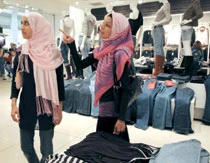
Isn’t this so cute?” cooed Hiba Khan, admiring a loose-knit vest glimmering with a sequined brown collar at Tysons Corner Center’s LVL X clothing store. Sexy, the 21-year-old Fairfax City, Va., resident admitted, but that’s easily remedied with a long-sleeve top and a properly fastened head scarf.
In the hip young Muslim crowd, modesty is always in.
“I usually try not to buy anything too flashy or too revealing, but yeah, I want to look nice,” she said while at the mall one recent afternoon for a little back-to-school shopping in Virginia.
With summer coming to a close and classes starting, she and a half-dozen other college students were in search of “sister-friendly” clothes — attire that conforms to Islamic dictates but appeals to a contemporary sense of style and beauty.
But sticking to Islamic standards of modesty isn’t always easy, and it doesn’t always come naturally to girls raised in the United States, where MTV and Hollywood are more likely than religious texts to set fashion standards. Choosing to follow Islam’s clothing guidelines is often the result of a deep desire for cultural identity or religious soul-searching — especially for young women such as Khan, who as a teen-ager decided on her own to adopt the clothing standards of her religion.
That doesn’t mean she and other young Muslim women want to put aside a desire to be pretty.
“We want to look beautiful, but we don’t have that pressure to be sexy,” said Khan’s friend Khadija Amjad, 21, of Centreville, Va., dressed in a sleek black-and-purple ensemble that stretched to her ankles. The outfit was topped by a pink-and-purple hijab, or head scarf.
Estimates of the number of Muslims in the United States vary from 3 million to 7 million.
Muslims, men and women, are required by their holy book, the Qur’an, to be modest in their attire, Islamic scholars said. How the guidelines are interpreted varies by geography and family tradition, from simply avoiding form-fitting or revealing clothes to covering oneself with a head-to-toe burqa.
“The whole thing goes back to the presence of God,” said Akbar Ahmed, chair of Islamic Studies at American University. “You need to be in a state of decorum. You must ask yourself: How would God like to see me?”
Rika Prodhan, 22, a recent graduate of George Washington University, never worried too much about her form-fitting outfits and cascading hair when she was growing up in Houston. But as she matured into an observant young Muslim woman, a nagging voice in the back of her head grew louder. She recalls it telling her that the Qur’an was unambiguous — the body, including the hair, should be well covered.
While in college, she gradually adjusted her wardrobe to better reflect her religious convictions, eventually purging it of clothes that revealed her ankles or wrists. Finally, after much introspection, she began wearing the hijab, a big step that she knew would forever change the way she was perceived in public.
“I tried to find every reason not to wear it,” she said. “But I came to the conclusion it was like listening to your parents. We may not know the wisdom behind it now, but we’ll realize it later.”
Her parents, she said, actually were troubled by the decision, fearful that she was becoming “too Muslim” and isolating herself from mainstream society.
Today, though, they respect her decision and are glad she wears the hijab, which she said she sees as a sacrifice for God.
These days the hijab has become a flashpoint of controversy over women’s rights, religious extremism and terrorism — a symbol in some eyes of more radical Islam. The French government banned the hijab in schools. But for Khan, Amjad and Prodhan, it’s an expression of cultural and religious identity as well as a fashion accessory to be matched with a stylish handbag or jacket.
Modest doesn’t have to mean ugly, said Sarah Ansari, co-owner of Artizara.com, a San Diego-based company that sells modest clothing with a modern flare.
Her site features wide-leg pants, tops that go up to the neck and down past the buttocks, and tailored jackets that cinch in a bit — but not too much — at the waist. Her best-selling item, she said, is a flowing tie-dye skirt festooned with sequins, a staple offering at any youth-oriented mall clothing store.
“I don’t think there’s anything in Islam that precludes women from looking attractive or professional,” she said. “No one says you have to look like a bag lady. Actually, the Prophet Muhammad (PBUH) was known for wearing perfume, being clean and very well dressed.”
The Qur’an on Clothing
Chapter 24
Verse 30: Say to the believing men that they should lower their gaze and guard their modesty: that will make for greater purity for them.
Verse 31: And say to the believing women that they should lower their gaze and guard their modesty. ... They should draw their veils over their bosoms and not display their beauty except to their husbands, their fathers, their husbands’ fathers, their sons, their husbands’ sons, their brothers or their brothers’ sons, or their sisters’ sons, or their women, or the slaves whom their right hands possess, or male servants, or small children.