
Damascus — the oldest continually inhabited place on earth where ancient ruins and modern gleaming skyscrapers both compete for the visitor’s attention. Whether strolling through the ruins of ancient sites is your thing, or whether you prefer hunting for bargains in the Souqs, Damascus has something to offer everyone, as Christine McNeil found out.
FRIENDS had warned me that I would struggle to fit the highlights of Damascus into a single day, so rather than wasting time trying to hail a taxi on the city’s busy streets I decided to hire a driver to take me around the attractions.
Hertz Syria provided me with Habbab, an extremely courteous Damascene only too happy to share anecdotes and local legends in flawless English as we headed towards my first destination: the old city.
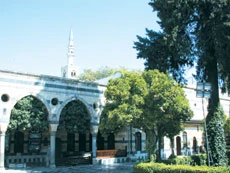
Fortified by an ancient Roman Citadel, the old city is home to the famous Ommayad Mosque which dates back to the eighth century. An imposing spectacle, it is surpassed only by the mosques of Makkah and Madinah in terms of sanctity and historical significance.
Throughout its 3,000 year history the building has played host to worshippers of a multitude of faiths and at one point was shared by Christians and Muslims who each worshipped at a different end of the building. The structure I found myself looking at was the result of a rebuild at around 700AD, and what a grand and impressive sight it was.
Habbab had encouraged me to take a look around, assuring me that I would be made welcome. And so I was. The courtyard leading to the Mosque is a tranquil relaxed place used as a meeting place by Damascenes of all ages who congregate to catch up with the gossip or simply to relax in the shadow of their city’s most beautiful monument.
Western visitors are provided with a hooded robe at the mosque’s entrance and are free to look around at their leisure. I could have spent the entire day there. Strolling beneath the massive colonnades on gleaming marble paving I was overwhelmed by the grandeur of the place.
The silver shrine in the center of the vast ceiling of the prayer hall is said to contain the severed head of John the Baptist and was the subject of many curious inspections by Syrians and tourists alike. I decided to forfeit a closer look and instead took time out to admire the mosaics and minarets along the main portal.
These beautiful mosaics in green, turquoise and gold once covered every single wall and ceiling in the building but had mostly been stripped away throughout centuries of sackings and lootings. I could barely imagine what the site would have once looked like in its original state.
Reluctantly leaving the mosque behind, I headed south along the narrow alleys towards the Al Azem Palace, once the home of an 18th Ottoman governor and now a museum. The palace is a brilliant example of ablaq masonry, the region’s characteristic black and white banding of sandstone and basalt. Inside the rooms pay tribute to the glory days of the Ottoman Empire with their grandiose tiling and paneling, and life at the palace is recreated in a series of dioramas.
My historical tour through the ages continued with a visit to the National Museum, home to a vast collection of ancient, classical and Islamic artifacts. I had planned to look round within an hour but ended up lingering for three fascinated by the insight I was given into life throughout so many different ages.
The artifact that caused me to pause for the greatest amount of time was a stone tablet, no bigger than a packet of chewing gum. On it was inscribed the first known example of an alphabet — I wondered what hand had carved it, a loving father perhaps, teaching his son this new novel way to communicate thoughts and ideas.
I couldn’t leave the old city behind without paying a visit to the famed Hamidiyeh Souq to hunt for souvenirs. I ambled my way through narrow alleys pausing to look at intricate silver work, pearl inlaid woodwork and of course – carpets.
After spotting some excellent gifts for my family I was able to enlist Habbab’s help in negotiating a good price from the stall holders. An expert haggler, he even managed to half the price of an intricately patterned carpet I had my heart set on.
By this time it was late afternoon and after loading my spoils into the car we headed off to Jebel Qassiom, a mountain behind the city commanding excellent views. It was from this very mountain that the prophet Mohammed likened Damascus to paradise. Taking a seat and watching the sun set and the gradual switching on of the city lights was a perfect way to end the day.
The next morning Habbab was awaiting me at my hotel for a 7.30am start. Although I am really not a morning person I wanted to allow as much time as possible to explore the ruins of Palmyra which was where we were headed.
Once a thriving oasis on the silk route Palmyra is now famed for its ancient ruins is said to rival the sites of Greece and Rome. On our approach I was immediately struck by imposing limestone columns framed by blue sky.
At the site I employed a guide who was able to explain to me what each of the pillars now lying flat on the ground had once been part of and I began to develop a picture in my mind of what the city once would have looked like during the heyday of the Roman Empire.
Last summer I visited Rome during the peak tourist season and tried to explore the ruins of the Forum whilst being jostled by other tourists madly snapping away with their cameras and having my view obscured by large tour groups parking themselves in front of the very structure I planned to look at next.
Palmyra couldn’t be more different. I had the site to myself on arrival and as the day progressed I was joined by only a handful of other tourists, each of whom contemplated the ruins in their own quiet, unobtrusive way.
The site is simply enormous, and as we sat down to enjoy a picnic lunch my guide told me the story of Zenobia. An alleged descendant of Cleopatra, Zenobia claimed the Palmyrian crown after her husband the king died in mysterious circumstances. Her outspoken rule incurred the wrath of the Roman Empire and after being captured by Emperor Aurelian’s forces she was paraded through Rome in chains — earning her place forever in Syrian legend.
When it was time to go I headed back to the car along a regal walkway created by the restoration of 300 giant columns. It was time to leave Syria behind, and although I was sad to be leaving, I couldn’t shake off the feeling of exhilaration I had at seeing so much of the past in just two days.