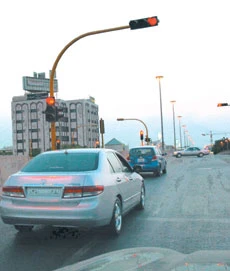
Week one of Ramadan in Jeddah is the equivalent of the warm-up lap for a Formula 1 race. As the prospect of iftar approaches, drivers accelerate toward red lights and brake hard — doubtless to get their tires warm for the start of the race home. At the red lights, engines running and the aroma of gently glowing clutches floating on the evening air, the drivers wait for the small boys and itinerant salesmen to leap clear — well, usually they wait — and at the green light and simultaneous outbreak of the cacophony of horns, the race home is on.
Week two is where the real event starts. Handicapped by a full seven days of largely sleepless nights and virtually sleepless days, the national handicap of tiredness is added to the race’s parameters. It is at this point that the accident rates begin to climb.
Ramadan and its obligations shouldn’t be a surprise to anyone in the Kingdom; the holy month has been around for some 14 centuries plus. That surely ought to be time enough to learn. Those barometers of social life — the shopping malls — have been advertising for weeks the fact that Ramadan is approaching.
Why then are drivers, who we must presume know about the event, apparently ignorant of the inevitable side-effects that come from fasting and quite literally turning night into day? Apart from the obvious pangs of hunger and bouts of hypo- and hyper-glycemia, brought on by the fasting followed by iftar infusions of sweet drinks and sugary cakes, there are the psychological effects and tiredness caused by the disruption of circadian (24-hour cycle) rhythm.
A study by pharmacologists in Morocco on the chronobiological effects of fasting showed that “Ramadan fasting affects the circadian distribution of body temperature, cortisol, melatonin and glycemia. The amplitude of most of these rhythms decreased and the acrophase (the point of maximum responsiveness) shifted. Nocturnal sleep, daytime alertness and psychomotor performance were decreased.”
The study went on to say that major changes during Ramadan fasting are chronobiological and behavioral. “They could be responsible for the high incidence of road traffic accidents and the reduction of working hours during the month of Ramadan.” Anyone who has driven in the panic hour just before Maghreb or the hyper-hour after iftar will nod at the wisdom of that cautions conclusion.
Hardly surprising then that road accidents were up 20 percent during Ramadan in 2004. Brig. Saad Al-Ghamdi of the Jeddah Traffic Department told the Arab News last year that accidents peak just before iftar.
“I have no idea why people behave so differently in Ramadan even though they are supposed to respect the spirit of the holy month by being patient and tolerant. This happens every Ramadan, despite our continued warnings. Motorists tend to speed more than usual and lose their concentration while driving.”
The brigadier cannot be expected to be fully conversant with the medical effects of fasting — any more than the average member of the driving public can. Is it not worrying that simple observations of their own actions, feelings and the behavior of fellow road-users have not triggered any thoughts on why all this might be happening?
Apparently not.
Public awareness campaigns rarely have profound effects on behavior unless they are enforced. The Kingdom’s commendable seat-belt campaign was rigidly enforced by police standing at traffic lights, pouncing on unbelted motorists and fining them.
Might it be time for them to target the iftar-racers? If awareness campaigns do not have any effect on the entirely predictable waste of lives during Ramadan, then perhaps the force of the law might.
Dubai has a neat approach to help slow the race. Minutes before the Maghreb prayer, the United Arab Emirates traffic police head for crossroads known for their traffic jams, to distribute iftar meals to drivers in a bid to avoid high speed race for home.
“Police officers distribute iftar meals to fasting drivers at the usually jammed crossroads,” said Nasser Al-Zeidi, rescue police chief, who was quoted by the Emirate news agency. Apparently if that has happened in the Kingdom, there is no evidence currently on the streets of Jeddah.
Even with affirmative action by the police, Dubai saw one accident reported every two minutes during the first three days of Ramadan. The number of accidents involving injuries or fatalities also jumped almost 50 percent, Brig. Muhammad Saif Al-Zafein, director of Dubai Police’s General Traffic Department, was reported as saying.
Maybe here, as in the seat belt campaign, it has to be stick and not carrot (or perhaps more appropriately, dates and water.) Relying on self-control and reasonableness of the driver is clearly a lost cause — whether that cause is cultural, psychological of simply biologically in origin. Stand at any set of traffic lights at 6 p.m. and establish the veracity of that contention by watching scores of drivers risking their lives by running red signals.
Traffic accidents are a major health hazard in Saudi Arabia, particularly during Ramadan, says a report by the Department of Neurosciences, Riyadh Armed Forces Hospital. The resulting injuries rise in direct proportion to the increase in the number of road vehicles. An audit of road traffic accidents over a one-year period revealed that, out of 361 victims in the study, 16 percent were less than 10 years old and 47 percent between 11 and 30 years.
“None of those involved in accidents was wearing a seat belt,” the report said, testimony indeed to the clampdown by police on errant motorists. “The introduction of seat belt legislation and stricter law enforcement should lead to a rapid reduction in morbidity and mortality on the roads in Saudi Arabia,” the report concluded.
The human and financial cost of the carnage on Saudi Arabia’s roads is huge. Between 1971 and 1997; 564,762 people died or were injured in traffic accidents, a figure equivalent to 3.5 percent of the Kingdom’s total population, said a study by King Khaled National Guard Hospital. In that period alone, 66,914 people died on the roads in Saudi Arabia due to road accidents — amounting to one person killed and four injured every hour. Over 65 percent of accidents occur because of vehicles traveling at excess speed and/or drivers disobeying traffic signals. Of deaths in Ministry of Health hospitals, 81 percent are due to road traffic accidents and 20 percent of those hospital beds are occupied by traffic accident victims. With the added biological and psychological pressures — often self-inflicted — in Ramadan, it gets worse.