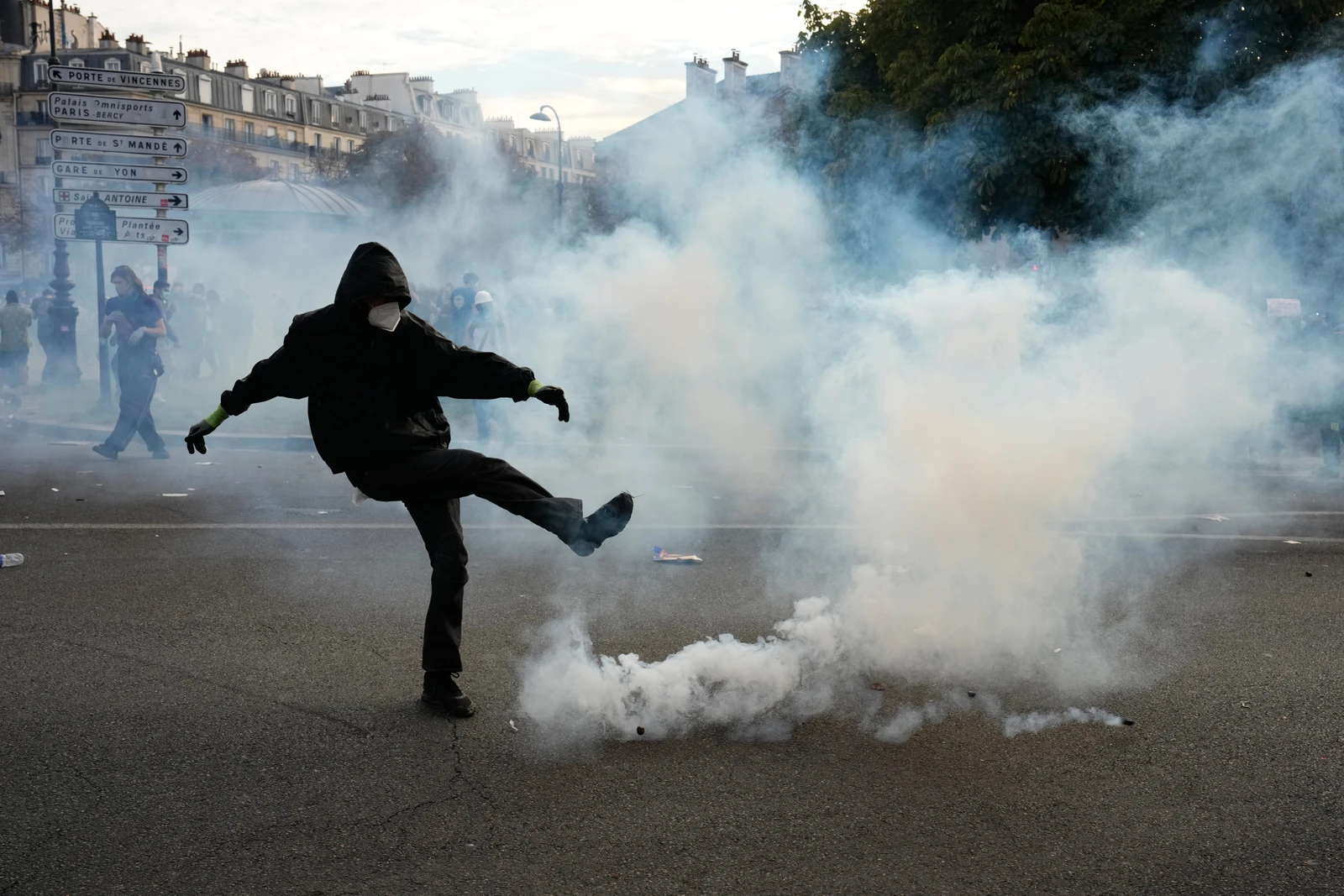
MANILA, 15 October 2005 — In yet another sign of increasing disquiet, several people were hurt and a number of respected personalities got an untimely bath yesterday as police unleashed water cannons on a protest rally seeking President Gloria Macapagal Arroyo’s resignation.
Among those drenched were former Vice President Teofisto Guingona Jr., who quit his last assignment as ambassador to China in June to join the clamor for Arroyo to step down after she was exposed discussing with an election officer the outcome of last year’s presidential election.
Also hit by water cannon were Roman Catholic Bishops Antonio Tobias and Deogracias Iñiguez, Senator Ana Consuelo “Jamby” Madrigal, party-list Representatives Satur Ocampo and Risa Hontiveros, former Sen. Wigberto Tañada and television show host Oscar Orbos.
The protesters numbering about 1,000 were trying to march to churches near the Malacañang Palace when police stopped them along Recto Avenue as they approached the historic Chino Roces Bridge (formerly Mendiola), scene of violent street protests over the past three decades.
“This is in complete violation of the rights of the people. This is a prayer rally,” complained the 77-year-old Guingona, a veteran of street protests against the dictatorship of the late Ferdinand Marcos in the 70s and 80s.
“We were peaceful. There was no reason to disperse us,” said Guingona, who fell to the ground in the initial confrontation after about 50 policemen pushed the marchers back with their riot shields.
Rally leader Bishop Julio Labayen, who stayed in a van due to his advance age, escaped the water blast.
Reminiscent of Marcos Years
Radio and wire reports said dozens of protesters were hurt. Among those in the march were priests and nuns, professionals, laborers, farmers and students.
“They’re crushing democracy ... This is martial law,” said opposition Sen. Jamby Madrigal, who claimed he was beaten by police.
Guingona’s daughter said she was grabbed by the neck by a plainclothes policeman.
The marchers had earlier assembled at Plaza Miranda before marching on to Recto, planning to go to San Beda Church, about 300 meters away from the gates of the presidential palace.
While marching, they sang church hymns, like “Immaculate Mother,” and the protesters’ battle song against Marcos, “Bayan Ko.”
The scene brought echoes of how riot troops during the rule of Ferdinand Marcos dispersed peaceful protests led by nationalist leaders Lorenzo Tañada, Jose W. Diokno and former pre-martial law Manila Times publisher Joaquin “Chino” Roces.
Forced to Act
At the time of the incident, Arroyo had finished speaking at a festival in Dumaguete City and was heading back to Manila.
Director Vidal Querol, police chief for Metro Manila, defended the dispersal saying the protesters did not have a permit. He said police were prepared to negotiate but were forced to disperse the crowd after a faction became unruly. “The area was peaceful until they arrived,” he said.
“They broke away from the religious procession and turned it into a political rally,” he said.
But Hontiveros, an opposition member of the House of Representatives, said the march had been peaceful until police fired water cannons unprovoked.
Hontiveros said the police brutality was apparently a result of the “no-permit, no rally” policy adopted by the Arroyo administration to suppress street protests.
Manila Mayor Lito Atienza had previously said that Mendiola Bridge was off limits to protesters.
Under the CPR, rallies without permit could be broken up, and rowdy protesters arrested. Critics have been challenging the Malacañang order by holding near-daily street protests.
The government says the protests are being used by Arroyo’s political opponents to foment discord to set the stage for a coup attempt.
Virtual Fortress
While downplaying the strength of protest actions against the administration, the administration has been setting up a virtual fortress in Malacañang to thwart protest rallies.
In a briefing yesterday, Press Secretary Ignacio Bunye said Malacañang would adopt the US policy prohibiting rallies within a broad perimeter around the White House. He said details of the no-rally zone were being finalized with Manila officials led by Mayor Atienza, who was present at the briefing.
Directing his message to protesters, Atienza said: “Please don’t force yourself on Mendiola. This has been the site of confrontational situations that have not been good to the country.”
He recalled as an example the “Mendiola Massacre” in 1987, where 17 farmers were killed in one of the bloodiest police dispersal operations in the country.
Atienza tried to justify the Manila government’s refusal to allow the bishops’ prayer rally on Mendiola: “I know what a procession is, but I hope our bishops would not take it against me. There is nothing wrong in going to church, but why do they have to pass a critical place? When we blend the political and the religious, there will be complications.
“In normal times, we could have allowed it. But we have a different situation now.”
(Input from Inquirer News Service & agencies)