
THE Prophet Mohammad (peace be upon him) advised us more than 1,400 years ago in several of his Hadiths to maintain our hygiene with oud and musk, which create pleasant, enduring scents for both body and hair that have become the aromas of Arabia.
Among the leaders in stores that specialize in these traditional fragrances is Abdul Sammad Al-Qurashi. “My family has been working in this field for more than 150 years, passing the job from fathers to sons,” said Turki Al-Qurashi, son of the current owner. “Arab men and women and even foreigners are interested in buying these traditional Arabian scents.”
Al-Qurashi told Arab News that people often choose the traditional scents as wedding or holiday gifts. Many men will use one of these scents before going to prayer, and they also have funeral applications.
Oud wood is a valuable and treasured item. Al-Qurashi said Indian oud was considered the best, but it has become very rare. A single kilogram of the wood can fetch between SR30,000 to SR120,000. Cambodia now is a big supplier, with Cambodian oud ranging from SR4,000 to SR15,000 a kilo.
Al-Qurashi prices for oud, bakhour and mamoul tend to be a little higher than their competitors, largely because they now operate their own plantation in Cambodia to ensure the quality and also the quantities needed. They figure the farm gives them adequate supplies for at least the next 20 years. Al-Qurashi said they acquired the Cambodian plantation after discovering that some suppliers were using a variety of substances — including lead — to pad the weight — and the price — of the oud wood. “We didn’t notice that because the sellers used to cover the carved hole neatly,” he said. “When we later discovered what they were doing we invested in the farm.” Now they control the quality from the field to the store shelf. “We import the wood and fabricate it in our seven factories and 15 laboratories in the Kingdom, United Arab Emirates, Kuwait, Qatar, Oman, Bahrain, Lebanon, Egypt and France where specialist employees make sure its pure oud — clean from any dirt or fungus,” Al-Qurashi said.
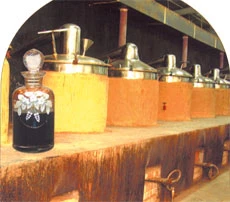
To get oud in liquid form is a complicated process. “We use wood from the Aquilaria tree that produces a sap when affected by a certain kind of fungus,” he said. “It takes a long period of time but this sap gets darker and thicker over time, and that’s what makes it rare and expensive.” It’s time consuming work. “That wood goes through a process after being cleaned,” he said. “The big pieces are cut into smaller ones and then into very thin layers as if cutting an apple peel.
After that, it goes through a boiling process where some water is added. Finally, when the water evaporates, some oil remains on the surface, and that is what they later combine with other dried flowers and plants.”
Some of the other ingredients used with the oud are Iranian saffron, Indian sandalwood oil, Tibetan deer’s’ musk and Alanbar whale liver excretions collected from the sea surface off Bab Al-Mandab near Yemen and thoroughly cleaned and sanitized for perfume use.
A special flower native to Bulgaria and Turkey also is cultivated in Taif and used with the oud. Al-Qurashi said customers in the Kingdom prefer the ones from Taif.
Albakhour on the other hand, is chopped oud wood that is soaked in oud oil for about three months for a wonderful scent when burned or a long-lasting aroma when placed in a dresser drawer or a closet. Mamoul, or round dough of crushed wood, oud and other ingredients, is another product sold by Al-Qurashi and used in the same manner as Albakhour.
How can you tell good oud from bad oud?
“If it smells good from the beginning it will last the same, and if it smells bad, it will continue to be the same,” Al-Qurashi concluded.
There’s no need to test the mass of oud wood by seeing if it will float on water, just enjoy the variety with the essence you prefer. If you’re unsure which type to choose, a salesman can ask you a couple of questions according to your personality. Your answers will give him the insights to suggest fragrances that may suit your tastes.
Making Sense of Your Own Scent
Although all these scents have their own distinctive fragrances, they become even more distinctive when a person applies them. According to the Fragrance Foundation, each human being has his or her own individual “smell fingerprint.” Our scents appear from the sum total of our heredity (genes), skin type, hair color, diet, medications ingested as well as our stress level and the environment in which we live in. So each fragrance reacts differently on each person. When body heat increases, the fragrance intensifies. Although scents certainly have a physical nature, they also can have a metaphysical nature.
When 1,634 people were polled on fragrances, many of the respondents said smells evoke memories with strong emotional qualities. The most common memories, as reported by the poll, were home and childhood, 45 percent; romantic relationships, 24 percent; friends and family, 11 percent; vacation or travel, 10 percent; and holiday celebrations, 9 percent.