JEDDAH, 17 October 2005 — It is often said that necessity is the mother of invention. Thus Saudis interested in the cultural scene have had to improvise and discover untraditional mediums of communication due to the almost total absence of cultural societies in the country.
In fact, there are two cultural governmental entities in Saudi Arabia: The Society of Arts and Culture and literary clubs. Though both have branches in major cities, worried writers continuously criticize their weak performance.
With limited budgets, both fall short of delivering a cultural message to Saudis. They are also blamed for producing their own bureaucracy, and this results in the failure to attract a wide audience, especially the young.
To sidestep the problem, many Saudis have opted for the Internet and have set up virtual forums dealing with a wide range of cultural activities such as photography, fine arts, poetry and fiction. The web is now flooded with the sites though the quality on each one is dependent upon supervisors as well as contributing members.
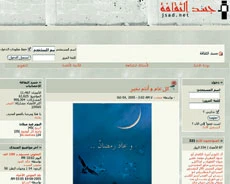
One of the best-known Saudi Internet cultural forums is Jasad Al-Thaqafa (http://jsad.net/) which can be literally translated into English as “Body of Culture.” Established five years ago, the website is not only known locally but internationally in the Arab world among writers and intellectuals. It quickly attracted a large audience, eager to speak their minds freely away from the constraints of the local media. The number of visitors sometimes is as many as 12,000 which is almost the circulation numbers for some local newspapers and magazines.
The mind behind the site belongs to Saudi journalist Turki Al-Dakheel. He is also the owner of the website. He gathered a number of his writer friends and launched it in 2000. The main mission of the website which was posted on the homepage raised a number of angry objections in the local press at the time. The mission stated: “In a time when the culture of flesh is dominant, we favor resurrecting a body of culture.” The media took the mission statement as an indirect offense and attacked it vigorously. Later the statement was removed from the homepage of the website.
“Our policy was clear from the beginning,” said Saeed Al-Ahmad, writer and general supervisor of the website. “We are against any kind of exclusion in thought.” He explained that different points of view are welcome — with only one condition: To respect one another’s opinions.
To ensure that users do not abuse the freedom of discussion on the website, a certain mechanism is used. The job of monitoring the topics of discussions in each section is divided between several supervisors. In cases of clashes between members, the supervisors may get directly involved, either by removing the topic from discussion or, in extreme cases, suspending the membership of members who cause trouble. “There is no absolute freedom in the world; absolute freedom means absolute chaos,” commented Al-Ahmad.
For writers, the site is a golden opportunity. Not only do they have the chance to post their opinions, concerns and even literary works, whether poetry or short stories, but they also receive immediate responses. Before such sites existed, writers were limited to expressing their views and publishing their works in newspapers and a few literary magazines. Writers, as they themselves say, were at the editor’s mercy; writers accuse them of bias as they promote certain names or thoughts excluding “the other” which might disagree with them intellectually or even personally.
Another major reason for writers resorting to the Internet is their wanting to escape random governmental supervision which “has no clear limits,” said Al-Ahmad. “What is allowed by the Ministry of Culture and Information is at least 15-20 years behind society’s present mentality,” he observed.
As with all publications, the authorities monitor the website as well. At the beginning, the website administrators had a number of “misunderstandings” with the King Abdul Aziz City for Science and Technology (KACST). The role of KACST, which was established by the government in 1997, is not only to provide Internet service to Saudis but to filter it as well. Though Al-Ahmad criticized the supervision, he was at the same time lenient in his judgment of KACST.
“At the beginning, the picture was not clear concerning the role of KACST; yes, there were objections and arguments but that ended once they got to know us.” He admitted, however, that KACST had shut down the site a couple of times for an hour or two.
Such websites have to put up not only with government supervision but also extremists’ attacks. The extremists — or as Al-Ahmad likes to describe them “The Internet Mujahedeen” — find the contents of the website too liberal for their taste and they have managed to hack it several times.
Saudi photographer Musleh Jameel has found the website the perfect place to display his photos in order to reach a wider audience. “The most important aspect is the ability to post your work whenever you want, and you find out people’s opinions in a matter of seconds.”
Saudi journalists make up a large proportion of visitors to the site. Rabah Al-Quwayi, a journalist with Okaz Arabic daily, is the supervisor for the website’s journalism and media section. He said that he had benefited a great deal from the website. “Although the accuracy of news on the website is questionable, it remains a good source of news,” he said.
Al-Quwayi also told us an interesting fact: “Being an active member gave me access to some well-known names that every journalist needs.”
Being a supervisor on the website did not go down well with his employers at Okaz. They told him indirectly that they did not want him working as a supervisor for the website. Up to now, however, he has managed to convince them that he is only a supervisor of the section and that what appears there does not necessarily represent his own personal views. His job is in fact managerial.
A unique recent achievement which was a first for Arab world cultural forums appeared on the website last week. It was a collection of 17 short stories which will soon be published and become available in local bookstores. The collection is entitled “The Spinning Wheel” and was to contain 34 stories; half of them were rejected by the ministry and so the rejected stories are to be published outside the Kingdom.
Though some members argue that the quality of the website is going down, it nonetheless remains a means of connecting Saudis from all regions, backgrounds and ages. It is almost a local version of Speakers’ Corner where people can say anything and be listened to. And, for those who do not agree, walk away or leave the website.