
DUBAI, 18 October 2005 — Most of us can’t imagine how we’d get through the day without computers. The machines are everywhere in our modern world. But ask the average man on the street if the handicapped can use computers, and a puzzled expression would probably be the answer. People simply still do not understand that computers are for everyone. If a person can move one muscle, then accessibility to computing technology is possible.
Sharjah-based Nattiq Technologies (www.nattiq.com) is working hard to get the word out that new developments in the field of adaptive technology are enabling every person in the Arab world to become computer literate. Nattiq is focused on bringing opportunities to interface with technology to the visually handicapped in the Middle East. The company specializes in the value added distribution of products and training for blind people.
Nattiq works to Arabize and then distribute core technologies from specialist providers such as Dolphin Computers, based in the UK, Clearview and Talx. These technologies include the award winning Hal/Supernova screen reading software for computers and PDAs, Ease Publisher software that turns any electronic text into a talking book and Talx talking mobile phone software.
Nattiq products are currently available through nonprofit organizations that sell on the products covering only their own costs, such as the Esbar Center in Jeddah and the Friends of the Blind Association in Palestine. Also, individual users of the products act as smallscale sales agents in Jordan and Saudi Arabia. Alongside its products, Nattiq provides training services aimed at getting blind people into the same jobs as sighted people.
Statistics from international organizations working on behalf of the handicapped, put the number of blind individuals in Saudi Arabia at over 100,000. About an additional eight percent of the population is visually impaired. There are also several thousand individuals who are both blind and deaf or have blindness coupled with another disability. The numbers of handicapped are divided between rural and urban areas, with slightly higher numbers in the urban areas. Education for the blind in rural areas is less accessible than in urban areas and in general, resources for the blind across the Kingdom are not ideal — although they have improved in recent years.
With all these facts in mind, it is easy to see that the need for adaptive technology in Saudi Arabia is high. Using adaptive technology, children do not need to be schooled in special facilities for the blind or visually impaired. Equipment such as screen readers and magnifiers allow children to use technology coupled with standard education texts. Students can take notes and complete assignments by typing into computers equipped with braille or speech functionality.
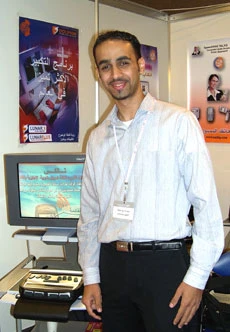
Outside of the education field, computers equipped with adaptive technologies allow individuals of all ages to access the Internet. As an example, Rami Yacoub, technical support engineer, Nattiq Technologies, demonstrated the Hal Screen Reader, which is available to handle both English and Arabic text.
“Nattiq is all about empowering people. The CD for the Hal Screen Reader loads automatically on the PC and gives easy verbal instructions for use. This means that a blind person doesn’t need assistance from anyone to use it,” said Yacoub.
Hal’s sophisticated technology makes all kinds of Windows applications, the Internet and e-mail easy to use. Hal works by recognizing and reading information from the computer screen aloud through the computer’s sound card. Screen information can also be displayed in Braille for users of the many supported Braille devices.
The information provided is comprehensive. Hal not only reads text, but also recognizes Windows dialogs, icons, buttons, menus and controls. For input, Hal talks as the user types, by character, by word or both.
For people who have partial vision, Nattiq offers a variety of options to help those individuals function well in a sighted world. Compact, a pocket size video magnifier with an integrated display, magnifies up to eight times. The Compact is laid down on or held against an object, magnifying the material. This means that those with partial sight can read the instructions on a prescription medicine bottle or classified advertisements in a newspaper. For larger reading jobs, the product, ClearView Bright, is a color CCTV that connects to any computer. The user simply places the material to be enlarged on the small platform under the CCTV and the text or photo appears in the desired size on the computer monitor.
Nattiq is looking for more vendors to work with in the Middle East. The company believes there is an opportunity for more vendors to invest in this niche area and strengthen the channels to market for products aimed at visually impaired people.
“Our goal is to provide blind Arabs with the tools to input and gain skills using computing and communication equipment. It is an easily achievable goal and we can provide all the necessary means through our services and training. In the west, by virtue of being blind, people qualify for help, over here they don’t get anything,” said Auda Hazeem, CEO at Nattiq Technologies.
He added, “Arab governments need to be more aware of, and invest in, their disabled. Currently blind people have to rely largely on the goodwill of others. At least vendors such as HP and Microsoft have social responsibility programs. We are looking for companies such as these to invest in and partner with us, so they can help us to bring the price of assistive products down and make technology more accessible to blind people.”
Nattiq’s staff emphasized that lack of awareness of the available adaptive technologies is crippling the blind and visually impaired in the Arab world. For example, parents of visually impaired children just do not know that from the earliest age their children can receive the same advantages that books bring to children with normal sight. By using magnifying and/or screen reading technologies, visually impaired youngsters can “read” the text and enjoy the illustrations in popular children’s literature.
Their early use of such technologies will allow them to feel comfortable with these tools and will increase their chances of success once they go to school. As for schools, Yacoub mentioned that in most countries across the Middle East, many education facilities, even those for the blind, do not promote the use of adaptive technologies.
“It is up to parents to be educated on what technology is available, so they can speak to the schools and insist that their blind or visually impaired children have the opportunity to use such technology to enhance their education,” he said.
Yacoub pointed out that older people can also be helped by adaptive technologies. Glaucoma, cataracts and other conditions can rob people of clear sight. But by using adaptive technologies, visually impaired individuals can lead very independent lives. Magnifiers can allow people to read, write and participate in hobbies. Screen readers can help people stay active in business and enjoy all the advantages of the Internet. The bottom line is that thanks to modern technology, visual impairment is now a condition to be worked around — not a handicap.
* * *
— (Comments to [email protected].)