
DUJAIL, Iraq, 20 October 2005 — Some Iraqis watched with relief as Saddam Hussein’s trial began yesterday, bringing to account the man who brutalized them for three decades. Others, particularly among the Sunni minority, angrily dismissed the trial as a US-manipulated kangaroo court, declaring they did not recognize the case against a man who still proudly styles himself “the president of Iraq.”
Saddam’s trial was broadcast with a tape delay on major television stations in Iraq, giving Iraqis a first-hand glimpse of their former dictator brought low in a Baghdad courtroom, where he faced charges of crimes against humanity.
For many Iraqis, justice was sweet — if long in coming. “The beautiful thing is that the trial is live,” said 25-year-old Hamid Hussein, watching in an electronics store in the southern Shiite city of Najaf. “It comes just in time ... now we start trying the criminals.”
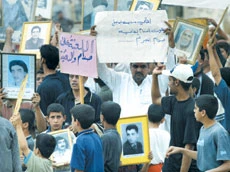
Emotions ran higher among others, reliving their own tragedies brooding over their own anger. “I wish that I could judge Saddam with my own hands,” swore Krav Nahid, who said his father was executed in 1991 when Saddam’s forces crushed a rebellion in Najaf following the Gulf War. “What I want is revenge.” The charges Saddam was facing stem from events in Dujail, a Shiite farming village about 60 km north of Baghdad, where local young men linked to the Shiite Dawa party, tried to kill the Iraqi ruler in 1982 as his convoy passed through town.
Prosecutors say Saddam ordered reprisals, telling his men to hunt down, torture and kill more than 140 men from Dujail. Families and friends of those killed said yesterday they hoped the trial would lead to swift conviction and execution. “This is the end of every tyrant,” said Laith Abd Mahdi, a middle-aged Dujail man outside his small house. “He hurt us, hurt my relatives and hurt my closest friends. Death is not enough for him.”
Others saw the trial as little more than a legal coda to the US-led overthrow of Saddam in 2003. “I don’t care about the trial,” said Abu Hamed, a bearded local man, with a small grimace. “Saddam Hussein was convicted when his statue was toppled and we saw it on TV.” Saddam gave his erstwhile subjects a defiant show yesterday, hectoring the special court set up to try him and claiming still to be Iraq’s rightful president. He eventually pleaded not guilty and the trial was adjourned until Nov. 28. Some Iraqis expressed frustration with the patchy quality of the broadcast. “If a government cannot even get the volume right on a thing like this, how can it run the country?” asked Adnan Hamed, 32, who was watching the trial in the northern city of Mosul. In Saddam’s hometown of Tikrit, a Sunni bastion 175 km north of Baghdad, chanting protesters took to the street to display their loyalty to their vanquished hero.
“The trial is unfair,” said student Dawud Farham, 18. “They should put on trial those who are tearing apart Iraq and its people.” Many Sunni Arabs, alienated since the US invasion, are in open revolt against Iraq’s Shiite- and Kurdish-led government which they fear is seeking to permanently end the long-favored position they enjoyed under Saddam, a fellow Sunni. Demonstrators, chanting “Long Live Saddam Hussein” and carrying banners emblazoned with slogans such as “Down with the occupation and the puppet government”, milled in the centre of town, closely watched by Iraqi police and US troops. “We sacrifice our blood and soul for you, Saddam,” one banner said, reviving a slogan from the former leader’s rule. Survivors of the infamous 1988 chemical attack on the northern town of Halabja gathered in coffee shops that opened especially despite Ramadan to watch Saddam’s trial on TV - although many said they would have rather watched him hang.
“As long as Saddam is alive, our suffering will never end,” said Pakhshan Mohamed Hama Mared, who lost three children in the gas attack, expected to form the basis of future genocide charges which could be lodged against the ex-dictator. In Kerbala, a Shiite city which like nearby Najaf suffered a brutal crackdown following the Gulf War, some residents said the television spectacular of a Saddam trial would do little to put his many wrongs right.

