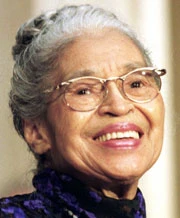
DETROIT, 26 October 2005 — Nearly 50 years ago, Rosa Parks made a simple decision that sparked a revolution. When a white man demanded she give up her seat on a Montgomery, Ala., bus, the then 42-year-old seamstress said no.
At the time, she couldn’t have known it would secure her a revered place in American history. But her one small act of defiance galvanized a generation of activists, including a young Rev. Martin Luther King Jr., and earned her the title “mother of the civil rights movement.”
Mrs. Parks died Monday evening at her home of natural causes, with close friends by her side, said Gregory Reed, an attorney who represented her for the past 15 years. She was 92.
Monique Reynolds, 37, a native of Montgomery, Ala., called Mrs. Parks an inspiration who had lived to see the changes brought about by the civil rights movement.
“Martin Luther King never saw this, Malcolm X never saw this,” said Reynolds, who now lives in Detroit. “She was able to see this and enjoy it.”
In 1955, Jim Crow laws in place since the post-Civil War Reconstruction required separation of the races in buses, restaurants and public accommodations throughout the South, while legally sanctioned racial discrimination kept blacks out of many jobs and neighborhoods in the North.
Mrs. Parks, an active member of the local chapter of the National Association for the Advancement of Colored People, was riding on a city bus on December 1, 1955, when a white man demanded her seat.
She refused, despite rules requiring blacks to yield their seats to whites. Two black Montgomery women had been arrested earlier that year on the same charge, but Mrs. Parks was jailed. She also was fined $14.
Parks said she had every reason to refuse to give up her bus seat to a white man in the face of an unjust law.
Detroit Mayor Kwame Kilpatrick said he felt a personal tie to the civil rights icon: “She stood up by sitting down. I’m only standing here because of her.”
Speaking to an audience of military spouses at Bolling Air Force Base in Washington, President Bush said Mrs. Parks’ 1955 refusal to give up her seat “was an act of personal courage.”
Bush described her as “one of the most inspiring women of the 20th century” and said that she would always have a “special place” in American history.
Speaking in 1992, Mrs. Parks said history too often maintains “that my feet were hurting and I didn’t know why I refused to stand up when they told me. But the real reason of my not standing up was I felt that I had a right to be treated as any other passenger. We had endured that kind of treatment for too long.”
Her arrest triggered a 381-day boycott of the bus system organized by a then little-known Baptist minister, the Rev. King, who later earned the Nobel Peace Prize for his work.
“At the time I was arrested I had no idea it would turn into this,” she said 30 years later. “It was just a day like any other day. The only thing that made it significant was that the masses of the people joined in.”
The Montgomery bus boycott, which came one year after the US Supreme Court’s landmark declaration that separate schools for blacks and whites were “inherently unequal,” marked the start of the modern civil rights movement.
The movement culminated in the 1964 federal Civil Rights Act, which banned racial discrimination in public accommodations.
In 1996, she received the Presidential Medal of Freedom, awarded to civilians making outstanding contributions to American life. In 1999, she was awarded the Congressional Gold Medal, the nation’s highest civilian honor.
Mrs. Parks received dozens of other awards, ranging from induction into the Alabama Academy of Honor to an NAACP Image Award for her 1999 appearance on CBS’ “Touched by an Angel.”
Looking back in 1988, Mrs. Parks said she worried that black young people took legal equality for granted.
Older blacks, she said “have tried to shield young people from what we have suffered. And in so doing, we seem to have a more complacent attitude.
“We must double and redouble our efforts to try to say to our youth, to try to give them an inspiration, an incentive and the will to study our heritage and to know what it means to be black in America today.”
At a celebration in her honor that same year, she said: “I am leaving this legacy to all of you… to bring peace, justice, equality, love and a fulfillment of what our lives should be. Without vision, the people will perish, and without courage and inspiration, dreams will die — the dream of freedom and peace.”