ISLAMABAD, 8 November 2005 — India and Pakistan opened a border crossing point in Kashmir yesterday to help the survivors of the Oct. 8 earthquake, but the occasion was marred by police firing on villagers rushing to enter India.
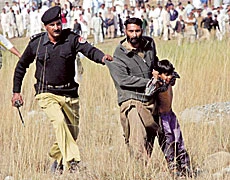
An angry crowd of several hundred gathered on the Pakistani side of the Poonch Valley, frustrated that civilians could not cross the frontier as earlier hoped. No one was reported hurt, but authorities arrested at least two men carrying young boys who made a vain dash for the border.
“We want a free Kashmir and we want to travel freely,” said one of the protesters, Mohammed Saffir Abbasi, a 57-year-old retired Pakistani Army soldier, as he wiped his eyes, streaming from tear gas that wafted across the fields, just 200 meters from the Line of Control, as the disputed border is called.
Pakistani officials said only quake aid would be crossing the line for now as paperwork, which includes an exchange of lists of those wishing to travel and security checks, had delayed hoped-for family reunions. Applications take about 10 days to process.
Pakistani officials also said force had to be used to avoid casualties from land mines planted on the border by forces of both countries over the years. Brig. Tahir Naqvi, the Pakistani official in charge of the crossing point, said authorities had de-mined certain routes and police were forced to fire tear gas when crowds fanned out around the Line of Control.
Pakistan’s Foreign Ministry said many Kashmiris were unaware of the procedures to cross the frontier. “Because of the widespread devastation the information about crossing procedures took some time to trickle down,” ministry spokeswoman Tasnim Aslam said.
“Lots of people did not realize that they would require application forms and clearances to be able to cross over,” she said.
“That is why not many people applied for permission to cross over. Instead they just walked up to the Line of Control to that point to go over.” The trouble broke out less than an hour after Indian and Pakistani officials shook hands across a length of white tape run across a ceremonial dirt square in no man’s land. India then started handing over 25 truckloads of tents, blankets, food and medicine, while Pakistan sent one truck of relief goods to India.
Most of the estimated 80,000 people killed in the earthquake lived in Pakistan’s side of the disputed Himalayan region and its North West Frontier Province. About 1,350 also perished on the Indian side. The opening was supposed to have been a much grander gesture: Letting Kashmiris cross at five points to check on long-lost relatives and visit relief camps set up along the frontier. But India demurred, and allowed only one crossing to open.
Braj Raj Sharma, a senior civilian official in India’s Jammu and Kashmir state, said once-a-week crossings of civilians should be allowed by next Monday at two points, and despite the delays he heralded yesterday’s events as “historic.”
No villagers from India’s side attended the aid exchange because of tight security there.
While of symbolic importance for the old enemies, opening the line is not expected to make a big difference to relief efforts. “We don’t need sugar, flour or rice or anything else. We just want to see our dear ones,” said Pakistani villager Sardar Abdul Hafiz.
— Additional input from agencies