JEDDAH, 10 November 2005 — UN Secretary-General Kofi Annan said yesterday he did not foresee US military action against Syria if it complies with a UN probe into the assassination of former Lebanese Premier Rafik Hariri.
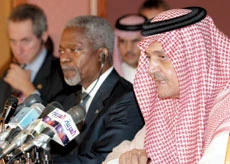
In a joint press conference with Foreign Minister Prince Saud Al-Faisal after meeting Custodian of the Two Holy Mosques King Abdullah, Annan also urged Riyadh to continue to push Damascus to cooperate.
“I have no indication that the United States is planning military action against Syria, regardless of the outcome of the investigation,” Annan told reporters. “In the discussion I had with governments, including with the United States, they would want to see Syria cooperate fully and help get to the truth,” Annan said.
Last month Syria, which has denied any involvement in Hariri’s assassination, dismissed a report by UN investigator Detlev Mehlis implicating its officials in the bombing that killed Hariri, saying the report was politically motivated.
Mehlis has asked to question six Syrian officials in Lebanon, including Maj. Gen. Asef Shawkat, according to a Lebanese source. Syria invited Mehlis to Damascus yesterday to discuss cooperation with his inquiry and proposed that the two sides sign a memorandum of understanding. “Whoever is incriminated in the assassination of former Prime Minister Hariri should be held to account ... regardless of the office of that person,” Annan said.
He reiterated comments he made in Egypt on Tuesday saying Syria had cooperated with earlier UN demands to redeploy its troops and security forces from Lebanon, and had also stayed out of recent elections in Lebanon. “It should continue this cooperation with Mehlis to get to the truth,” he added.
Asked if he had assurances that Washington would not take military action to force a regime change in Damascus, Annan said: “In effect, it will require some behavioral change on the part of certain governments. “And I think if that were to happen I would not see any need for any other initiative or the kind of action your question seems to imply,” he said.
The UN chief commended Saudi Arabia’s role in the fight against terrorism and said the world body would discuss Riyadh’s proposal of establishing a counterterrorism center as part of a global strategy.
Annan, who is visiting the Kingdom for the first time, discussed with King Abdullah major regional and international issues including Iraq, Palestine and Syria. “We had a good discussion with the king and congratulated him on his accession and the reform programs he initiated,” said Annan.
The main thrust of the press conference was on Syria. While talking on Mehlis investigation, Annan said: “The sole objective is getting to the truth and holding the perpetrators accountable. It is the beginning of a process. Impunity is not acceptable. Mehlis is following the evidence wherever it might lead, and whoever is implicated should be held accountable regardless of position.”
“Saudi Arabia is important in the region and plays a leadership role. We expect it to urge Syria to cooperate fully and honor the Security Council resolution,” added Annan.
Prince Saud said that Syria had promised to cooperate fully, and after the investigations only the perpetrators would be held accountable.
Meanwhile, Saudi Arabia expressed its support to the UN role in resolving international disputes in accordance with international law.
“We had a long and thorough discussion on various issues including Palestine and Iraq and reached joint agreements,” said Prince Saud. “The UN plays an important role especially at this time when there is turmoil and disarray in international relations. We depend on the UN to return things to order while following the international law,” he said.
Annan agreed with Prince Saud on the difficult times and the challenges before the world. He said the need of the hour was collective security and international cooperation. These challenges cannot be tackled by a single country.
On Iraq, Arab News asked what role he expects the UN to play considering that the US had practically pushed it out of Iraq and that it had lost some credibility after the oil-for-food program scandal, to which Annan said, “Although the Security Council debated thoroughly the issue of Iraq and did not vote in support of the war, it passed resolutions to help the Iraqi people, supported the electoral processes, the constitutional referendum, continues to support essential political processes there and also helps in the reconciliation efforts which is a long-term process,” adding, “I wouldn’t say we were pushed out.” He, however, did not refer to the oil-for-food program scandal.
On the shortfall of aid to Pakistan after the Oct. 8 earthquake, Annan said that UN tried to be assertive but the response has not been good. “Ten days after the tsunami, we received 80 percent of the aid needed. Ten days after the earthquake we only received 12 percent,” he said. “The media pleaded for more help, the situation is desperate and there is still the issue of recovery and reconstruction. There will be a donors meeting on Nov. 19 in Pakistan to raise more resources and urge individuals and governments to help generously. It is not lack of will but lack of resources,” said Annan.