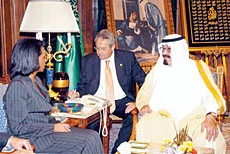
JEDDAH, 14 November 2005 — US Secretary of State Condoleezza Rice and Saudi Foreign Minister Prince Saud Al-Faisal inaugurated the US-Saudi Strategic Dialogue at meetings held yesterday and the day before. At a news conference yesterday they answered questions on Iraq, Palestine and Syria’s cooperation with the investigation into the murder of former Lebanese Prime Minister Rafik Hariri.
Rice said the United States would eventually pull its forces out of Iraq, that Washington was committed to the road map for resolving the Palestinian-Israeli conflict and that Syria had not shown a full desire to cooperate in the Hariri investigation.
Rice also said that she did not consider the recent Forum for the Future held in Bahrain a failure because the countries did not adopt a final declaration. She welcomed Saudi Arabia into the World Trade Organization and the course of reform Saudi Arabia has taken.
The Strategic Dialogue launched yesterday was conceived by President George W. Bush and Custodian of the Two Holy Mosques King Abdullah during their summit in April 2005. The objective is to strengthen, deepen, broaden and institutionalize the historic ties that have bound the two countries for over sixty years.
The dialogue is the beginning of what President Bush and King Abdullah described as a new era of “strengthening partnership that builds on our past, meets today’s challenges and embraces the opportunities our nations will face in the next sixty years.”
The Strategic Dialogue will be chaired by Secretary Rice and Foreign Minister Prince Saud and include senior officials from a number of departments and ministries in both countries. They will meet every six months, alternating in Saudi Arabia and the United States, to discuss issues of strategic importance to the two countries.
Six initial working groups have been established: Counter-Terrorism; Military Affairs; Energy; Economic and Financial Affairs; Consular Affairs and Partnership; Education Exchange and Human Development in the US and Saudi Arabia.
Prince Saud said he is now less worried that US policies in Iraq will bring on a civil war there, and pledged anew to contribute $1 billion for rebuilding that war-ravaged country’s shattered infrastructure. He said that now that steps had been taken to bring Shiites, Kurds and Sunnis together, “my fears which had been expressed earlier are much more eased.”
on the outcome of the Forum for the Future she attended in Bahrain, Rice said: “We talked in detail about human potential, how to enhance political participation and how to enhance empowerment of women. We established a fund for the future, which will help entrepreneurship and business, but perhaps the most important is producing the foundation of the future, the first institution of the broader Middle East initiative. At the very end, there was a concern about language concerning NGOs. I find that not signing the declaration over one point does not undermine what was achieved,” said Rice.
Prince Saud also would not call the forum a failure. “It goes to the credit of the US that rather than pushing a statement that some countries had reservations about, it decided to wait for a future meeting,” he said.
On the question of the Israeli-Palestinian conflict, both Rice and Prince Saud agreed that it was being used by terrorists to justify their actions which was exactly why it required urgent resolution.
“We believe that the road map is a reliable guide for a peaceful solution,” Rice said. Prince Saud added that Saudi Arabia’s position cannot be better defined than by King Abdullah’s proposal at the Arab Summit in Lebanon.