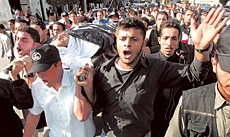
GAZA CITY, 15 November 2005 — Israel killed a Hamas commander and another Palestinian activist yesterday, jeopardizing peace in the region as visiting US Secretary of State Condoleezza Rice pressed both sides to reach agreement on Gaza border crossings.
Israeli troops arrived at the home of Amjad Hanawi, 34, the commander of Hamas’ armed wing in the northern West Bank, early yesterday, Palestinian witnesses said. The soldiers ordered every one out of the house and out of several surrounding buildings. The Israeli military said seven of Hanawi’s assistants gave themselves up, but he came out firing. Palestinian witnesses said Hanawi was shot as he tried to climb a fence to escape. Neighbors also said army dogs attacked several family members.
Hamas members drove through the streets of Nablus, announcing Hanawi’s death over loudspeakers. Hamas’ military wing, Ezzedine Al-Qassam Brigades, said in a statement that “the painful retaliation of Al-Qassam is coming.”
“We say to the Zionists that you are going to pay the price,” the statement said.
Since February, Hamas has largely adhered to an informal truce with Israel, and Israel has for the most part stopped pursuing the group’s wanted men. Its renewed practice of targeted killings has focused on the smaller Islamic Jihad movement, which has carried out four bombings since the truce went into effect.
Along the Israel-Gaza frontier, Israeli soldiers opened fire at gunmen spotted near the Israeli-built border fence, killing one of them and wounding two others, the army said.
Palestinian sources said the three belonged to the Popular Resistance Committees and were on a scouting mission.
Israel completed a pullout from the Gaza Strip in September, ending 38 years of military rule. Violence has flared frequently along the frontier since the withdrawal.
Israeli and Palestinian negotiators held unexpected talks on Gaza border crossings and Rice delayed her departure from the region, in a last push to reach agreement.
New arrangements at the crossings are crucial for reviving the Gaza economy. Israel and the Palestinians have been unable to seal a deal since Israel pulled out of Gaza.
Israel wants to maintain tight security at the crossings to prevent fighters and weapons from slipping through, while the Palestinians want to speed up the flow of goods to revitalize the economy and allow them freer movement.
Rice said after separate meetings yesterday with Israeli Prime Minister Ariel Sharon and Palestinian President Mahmoud Abbas that a deal on the crossings is “in sight.”
After the Rice-Abbas meeting, Israeli and Palestinians met for an unscheduled round of talks, Palestinian officials said. Rice delayed her departure from the region.
She was supposed to leave mid-afternoon for the Far East, but decided to fly to Jordan for several hours for a condolence call after the terrorist bombings that killed nearly 60 people at three Amman hotels last week. She was to return to Jerusalem later.
“We are still working on some issues on both sides,” Rice spokesman Sean McCormick said.
Late Sunday, international mediators had presented a draft agreement to both sides, with a request for rapid approval, an Israeli official said on condition of anonymity because the official was not authorized to speak to the media.
The proposal would include an Israeli commitment to allow 150 truckloads a day of Palestinian goods to pass through the Karni cargo crossing between Gaza and Israel, a large increase over the daily average of 35 trucks over the past six months.
At the Rafah crossing between Gaza and Egypt, negotiations reached a deadlock over whether Israel should be able to follow traffic via live closed circuit TV transmissions. The Palestinians have balked at the demand.
Under a compromise, the live pictures would be transmitted to a liaison office with Palestinian, Israeli and European representatives, with the Europeans put in charge. Israel closed Rafah before leaving Gaza.
The draft also calls for a resumption of Palestinian movement — in bus convoys escorted by Israeli troops — between the West Bank and Gaza, starting Dec. 15. The so-called “safe passage” was in place for about a year before intifada erupted in late 2000.
— Additional input from agencies