GAZA CITY, 16 November 2005 — Working overtime, US Secretary of State Condoleezza Rice yesterday brokered an accord between Israel and Palestinians on Gaza border crossing. The arrangement comes into effect Nov. 25 and allays Palestinian fears that the Gaza Strip would become a giant prison.
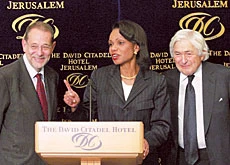
Flanked by EU foreign policy chief Javier Solana and former World Bank chief James Wolfensohn, who played a mediating role in the deal, Rice told reporters in Jerusalem that the two sides had resolved outstanding issues. “I am pleased to announce today that Israel and the Palestinian Authority have concluded an agreement on movement and access,” she said.
Rice had postponed a flight to Asia to throw her personal prestige into an effort to win a much-needed victory for the moribund Middle East peace process.
“It is the first time that the Palestinians are going to control an international border with the external world. This is also the first time that Israel accepts a European involvement in security matters,” said Solana.
Meeting the top EU diplomat, Israeli Prime Minister Ariel Sharon thanked the European Union for its efforts in advancing the Rafah agreement and taking up a third-party role by monitoring security at the crossing, his office said.
The Palestinian Authority welcomed the deal as important toward improving the life of the impoverished territory’s 1.3 million residents, happy that Israel would no longer control the crossing.
Rice said the Rafah crossing between Gaza and Egypt, the strip’s gateway to the outside world, should open Nov. 25 with the presence of European Union security monitors.
Palestinians would also be able to start traveling in bus and truck convoys between Gaza and the occupied West Bank within months, and construction of a Gaza seaport would begin.
The main sticking point was Israel’s insistence on monitoring passage of goods and people, saying it feared cross-border arms smuggling to militants. Palestinians said an Israeli presence at Rafah would impinge on their sovereignty. A compromise was reached whereby Israeli and Palestinian security officers at an EU-run control room a few kilometers from Rafah will monitor movement of goods and people through remote-control cameras. If the Israelis want someone stopped or detained, they must ask their Palestinian counterparts to take action. If the Palestinians refuse, it can be appealed to the EU team of police experts, which will be led by an Italian general.
Israel, which has kept control of Gaza’s borders, air space and sea lanes since its withdrawal, has been under US pressure to reopen the Rafah crossing, mostly closed since September. Sporadic violence despite a cease-fire has dented peace hopes.
US officials had voiced frustration with what they viewed as the failure of both sides to capitalize on the Gaza withdrawal, the first removal of settlements by Israel from land Palestinians want for a state.
In Gaza, one of the world’s most densely populated places with a population of 1.2 million, Palestinians welcomed the deal as a way to ease their hardship. “This is a good start and a good omen,” said Um Nizar Batran as she waited near Rafah to take her sick son to Egypt for treatment. International Middle East envoy James Wolfensohn, who had threatened to quit out of frustration over the impasse, thanked Rice for giving the negotiations the push they needed.
The agreement could give President Mahmoud Abbas a boost in January parliamentary elections in the face of a strong challenge from Hamas. In a speech after the Gaza deal was unveiled, Abbas accused Israel of trying to avoid peace talks and incite Palestinian civil war by insisting that militants be disarmed before any negotiations on statehood.
— Additional input from agencies