
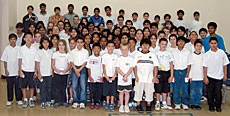
JUBAIL, 18 November 2005 — For expatriate students one of the advantages that the Kingdom offers is the chance to study at an international school. These fully accredited institutions allow students to receive a standard of education on par with schools in the US or UK, with the added experience of studying side by side with students of many nationalities. In such an environment, students learn to function in a global village, where tolerance is the key to congenial relationships.
In remembrance of the UN’s International Day of Tolerance observed on Wednesday, students from ISG Jubail, a member of the International Schools Group, expressed their thoughts on tolerance in our world. Tolerance is all about recognizing and respecting the views of others, without sharing those views. The students discussed questions such as “Are we tolerant of each other?” “If people were more tolerant of others how could that improve our world?” And of course, “What happens when people are intolerant of others?”
“Intolerance of people and their beliefs can lead to anger, which leads to hatred, which inevitably leads to conflict and war,” said Grade 9 student Isaach Majid. “If people were more tolerant of each other, the world would not have as many conflicts as it has now.”
Grade 4 student Joseph Palma Asuncion from the Philippines agreed. “If people in the world would just stop fighting and wasting time on wars, and talk things out, then the world would be a better place.”
The students clearly understand that respecting others is important. Some have had personal experiences with the concept of tolerance.
“In making friends, we shouldn’t choose who to like based on whether the person is rich or poor,” said Anisa Adimar, Grade 6.
“I am from South Africa,” said Kayla. “Before, whites couldn’t get along with blacks in South Africa, but now they can.”
“At our school we celebrate both Ramadan and Christmas,” said Eunice.
Mujtaba Fuad was quite direct in explaining that when people are intolerant, they are actually “rude.” Harris Khan added that, “Intolerant people don’t get very far in life because no one wants to be around them.”
While many students looked at tolerance from a “big picture” point of view, some noted the importance of tolerance in everyday life. “How many traffic accidents are there every year?” Natuja asked. “Right now the Saudi roads are deadly due to intolerance. If people were more tolerant in their cars, fewer people would be dying on the roads.”
“Just imagine that you’re standing in line in the cafeteria waiting for your food and the person in front of you is taking a lot of time,” said Hanin Abbas, Grade 8. “If you start screaming at that person to hurry up, the cafeteria lady will get angry and you won’t be served. You lose. If you are tolerant though, eventually in the end you usually get what you want.”
The students were full of good advice on why people should be tolerant. “Practice tolerance and you will have friends and not be lonely,” said South African Liezl Hanekom. “Tolerance allows people to communicate better,” said Iraqi Forkan Shareef. “Tolerance is the best quality to help a person be successful in life,” said Pakistani Armaghan Cheema. However, Saad Jamil, Grade 9, felt that too much tolerance wasn’t for the best.
“In my opinion, tolerating something is not always good. I would curse people who tolerate terrorism, corruption and many other things. There has to be a balance between tolerance and intolerance, but I feel there is none of that balance left.”
And Mehwish Khan, Grade 9, supported the concept of tolerance, but had one concern. “Some people just can’t accept the variety of differences among us. If they did then there would be more peace in this world. Wouldn’t that be boring though?”
Begging to differ with Mehwish, but it seems that this world could definitely use quite a few boring centuries of peace and tolerance if we are all to survive.