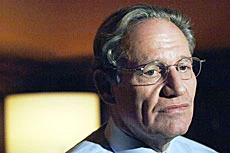
WASHINGTON, 18 November 2005 — Bob Woodward may be too good at keeping secrets. As America’s best-known investigative journalist, he kept his word for more than three decades and did not disclose the identity of Deep Throat, the FBI source who was at the center of the Watergate controversy. He even allowed his own paper, The Washington Post, to be scooped this year on Deep Throat’s identity.
But now nobody is praising Woodward for his ability to keep a secret in a more recent scandal. While publicly commenting and criticizing the role of a public prosecutor on the affair of an ousted CIA agent, he hid from his newspaper that a senior Bush Administration official had leaked the agent’s identity to him two years ago.
The leak eventually led to the indictment of Lewis “Scooter” Libby, Chief of Staff to Vice-President Dick Cheney on charges of perjury, obstruction of justice and making false statements, and the resignation of the New York Times reporter Judith Miller, who spent 85 days in jail to protect her source — Libby.
“He made a mistake and he apologized for it,” said The Washington Post’s executive editor, Leonard Downie Jr., who Woodward told only last month of his involvement in the affair.
At the heart of the affair was the alleged leaking by Administration officials of the identity of Valerie Plame, the covert CIA operative, as part of an effort to discredit her husband, former diplomat Joseph Wilson, who had written a report that undermined the Administration’s claim that Iraq had sought uranium for its nuclear program from Niger.
Ms. Plame’s identity was revealed in a column in July of 2003 by conservative journalist Robert Novak, who implied Wilson was sent on the Niger mission only because his wife got him the job.
Woodward said he kept his knowledge of the Plame affair secret because he did not want to be subpoenaed by Special Prosecutor Patrick Fitzgerald, whom he has called a “junkyard dog”.
Eric Boehlert, author of a coming book on the Administration and the press, said: “It looks like what people have been saying about Woodward for the past five years is true, that he’s become a stenographer for the Bush White House.”
Woodward’s admission touched off a uproar in Washington on Wednesday, raising questions about his silence, the thoroughness of the government’s investigation of the case, and the identity of yet another top Bush Administration source.
Although Woodward did not publicly reveal the senior Administration official’s identity, he did say it was not Libby. A spokesman for White House adviser Karl Rove, who remains under investigation, said Rove did not talk about Ms. Plame to Woodward.
Woodward, a member of the reporting duo that exposed the Watergate scandal that led to the resignation of president Richard Nixon, and currently an author and assistant managing editor of the Washington Post, said his knowledge of Plame made him the first journalist known to have been leaked information about Plame.
Woodward has also been caught lying to the public about his knowledge of the case. In a recent interview with Larry King on CNN he denied that he had any significant information about the case, and even claimed that he had said this to his editor after rumors circulated that he had a hot story about the Plame affair.
Woodward’s revelation brings into question the effectiveness of the two-year Fitzgerald investigation, as it appears someone was spreading Ms Plame’s identity earlier than previously known.
Those familiar with the case admitted being shocked that Fitzgerald had not rooted out the conversation earlier.
Woodward wrote in the Post that, with the permission of his source, Fitzgerald had interviewed him under oath this week after the unnamed official told the prosecutor on Nov. 3 about the conversations.
In a more-than-two-hour deposition, Woodward said, he told Fitzgerald that the unnamed official had casually told him in mid-June 2003 that Plame worked as a CIA analyst on weapons of mass destruction. Woodward said in an interview that he had not thought that her position was classified. Most analysts at the CIA are not working in a covert capacity, but Plame, a veteran overseas agent, had kept her covert status.
It is illegal to knowingly disclose the identity of a covert operative.
The incident highlights once again the almost-incestuous relationship between leading journalists in Washington and their highly placed sources.