
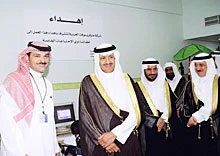
ALKHOBAR, 29 November 2005 — Prince Sultan ibn Salman, chairman of the Disabled Children’s Association (DCA), has inaugurated a special computer laboratory at DCA’s Center in Makkah. Donated by Microsoft Arabia, the lab is intended to help children with special needs learn, use and develop basic computer skills in a properly equipped environment that meets their special requirements. At the opening, Prince Sultan toured the location and listened to a brief on the lab and the services it offers to the children.
The DCA board chairman praised the initiative taken by Microsoft Arabia. The company worked closely with the association’s Makkah center to establish the lab, which included securing appropriate computer accessories for the children. These accessories were specially imported from the United Kingdom.
“This is a bright example of a successful community contribution project, which private sector companies should be keen on, each in their respective fields,” Prince Sultan remarked. He invited Microsoft to participate further in DCA’s information technology-related projects and its branches and centers Kingdomwide. Prince Sultan also emphasized the role of such a technology facility in providing children with special needs an ideal environment that caters to their unique mental and physical abilities and contributes to their development.
In response to the prince’s comments, Microsoft Arabia General Manager Dr. Khalid Al-Dhaher stated that Microsoft’s contribution to DCA is in perfect harmony with the company’s genuine interest in being part of community projects and initiatives that benefit all sectors of the society.
“We equipped the computer lab at the DCA Makkah Center with 12 workstations which were custom made for comfortable use by the children, who have been given extensive training in computer skills during the past few months,” said Dr. Al-Dhaher. He added that this is only the first of many initiatives the company hopes to introduce for special needs individuals in Saudi Arabia.
Microsoft Arabia has also recently completed printing a book on accessible technology for use by teachers. The title is an Arabic translation of a Microsoft publication, “Accessible Technology: A Guide for Educators.” The aim of the book is to help teachers in the Arab world learn how to use technology to enable special needs students — whether in a mainstream classroom environment or in a classroom for students with disabilities.
The book discusses the technologies available to allow special needs individuals to use computers and the Internet. Depending on the disability, sometimes all that is required is a minor modification of the display or the keyboard controls to provide for ease of use of the computer. The new Microsoft book gives instructions for how to make such changes and also advises educators about online resources to expand on individual issues. Microsoft Arabia is finalizing plans for distribution of the book across the Middle East.
“As computer labs are more common in schools it is essential that all children have the opportunity to use this technology,” said Mustafa Younes, marketing manager, Microsoft Arabia. “More and more special needs children are being ‘mainstreamed’ into classrooms. Teachers must have information on how to help these youngsters reach their learning potential. There are some misconceptions that children with disabilities cannot use computers. Our new Arabic publication on assistive technologies debunks that myth and guides educators in the best ways to enable special needs students to use modern information technology.”
Microsoft Arabia is hoping that the guide will not only be used in classrooms, but that parents who have special needs children at home will be encouraged to help those youngsters use computers. The Kingdom has recently launched an initiative to provide computers to Saudi families. In many cases, these machines with small modifications to the operating systems, can be used by children with disabilities such as low vision or cerebral palsy. By adding inexpensive input devices such as joysticks, children suffering from certain forms of paralysis can also use the computer.
“There is a whole world available to everyone out in cyberspace,” said Younes. “Children and adults who are unable to move about freely due to a disability can still be taught to get online. Then the vast world of the Internet is in front of them. In the virtual world there are no boundaries, no limits. Online, individuals with special needs can interact with others, completely freed from their disabilities.”
Microsoft Arabia believes that once teachers and parents understand the abilities that can be encouraged in children by using assistive technologies, that there will be an increasing demand for these technologies in the region. Until now, companies marketing assistive devices and software have struggled to stay in business, not because the need is not there, but rather because awareness of the technologies is lacking.
The truth is that with the assistive technologies now available, students with special needs can use computers and function well in a standard school environment. Students who cannot, due to serious physical handicaps, travel to school on a daily basis, may be educated using online resources. Beyond education, assistive technologies can enable recreation and entertainment for special needs individuals at home, vastly enriching their lives.
After an Arab News article in October on assistive technologies in the Middle East, we received an e-mail from Roshni I. Purohit. A visually impaired freelance journalist and policy professional, living and working in Scotland, Roshni has been blind since birth. Along with her family, Roshni has campaigned throughout her life for equal access to services for blind and visually impaired people.
“I was raised in a family who simply did not regard disability as defining an individual as being deficient or different, so I lived an active and fulfilled life, engaging in activities on a variety of levels, never feeling that my blindness held me back in any way,” Roshni wrote. “It came as quite a shock when I learned that the rest of the world did not quite think the same way. I spent last year working in Karachi, Pakistan as a senior broadcast journalist with a new radio project, and I was also teaching English in the Sindh Government School for the Blind. My time there was a real learning experience, and opened my mind to the enormity of the nature of discrimination facing blind people.”
In her e-mail Roshni explained that in the UK, special needs individuals are protected and enabled by government legislation. There are also several organizations with a mission to help the handicapped live independent lives, integrated into local communities. Roshni is currently working with other journalists and advocates of the disabled to organize a conference, to be held in Pakistan next year, to highlight assistive technologies. The conference organizers hope that the event will empower the disabled and help break down the cultural barriers inflicted on special needs individuals.
(Comments to [email protected].)