
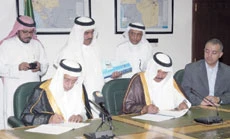
JEDDAH, 1 December 2005 — Water and Electricity Minister Abdullah Al-Hussayen yesterday signed contracts worth more than SR709 million to establish six new desal plants in Al-Wajh, Amlaj, Rabigh, Laith, Qunfuda and Farasan.
Speaking to reporters after the signing ceremony in Riyadh, Al-Hussayen said the new projects would double water supply in villages and towns on the Kingdom’s west coast and end the water crisis there.
He said the new desal plants in Al-Wajh, Amlaj, Laith, Qunfuda and Farasan would supply additional 9,000 cubic meters of water each daily while the new Rabigh plant would pump 18,000 cubic meters of water daily.
He said the privatization plan for the existing desal plants had made considerable progress. The Kingdom launched privatization of desal plants by awarding a SR9.1 billion contract to a consortium of Saudi and Malaysian companies in order to set up the third plant in Shuaiba.
He said the Shuaiba-3 would supply 194 million gallons of water daily as well as 900 megawatts of electricity. Work on the project will start Jan. 21 and its first unit will begin production Oct. 13, 2008. The Shuaiba-3, which is to supply water to Makkah, Jeddah, Taif and Baha, is one of the world’s biggest co-generation projects for the production of water and electricity.
He said the Supreme Economic Council, chaired by Custodian of the Two Holy Mosques King Abdullah, has approved four independent water and power projects. They are: Shuaiba-3, Shuqaiq-2, Ras Al-Zour, and Jubail-3.
The minister estimated the total cost of the four projects at SR30 billion. The private sector will contribute 60 percent of their cost while the state-owned Public Investment Fund (PIF) will have 32 percent stake and Saudi Electricity Company (SEC) 8 percent of the four projects.
The combined production capacity of the four projects will reach 492 million gallons daily and 4,500 megawatt of power. “These projects will boost the total desalination capacity of the Kingdom by 80 percent,” Al-Hussayen pointed out.
Al-Hussayen said the Kingdom would require nearly SR350 billion in investment for water and sewage projects and SR340 billion for electricity projects during the next 20 years. He said the water and electricity sectors in the Kingdom were growing at the rate of seven percent.