BEIRUT, 7 August 2006 — At least 15 Israelis were killed and dozens wounded yesterday by Hezbollah rocket fire as Israel faced its bloodiest day on the home front since launching its offensive in Lebanon.
Eleven people in Lebanon were killed by Israeli fire while world powers at the United Nations tried to persuade both sides to back a resolution aimed at ending the 26-day-old conflict.
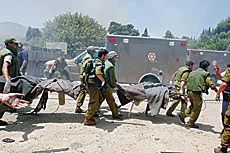
Twelve members of an Israeli reserve infantry unit who were camping near the town of Kfar Giladi close to the Lebanese border were killed in the single deadliest rocket attack since Israel launched its offensive in Lebanon on July 12.
At least three people were killed and more than 30 wounded in heavy rocket fire on Israel’s third largest city of Haifa, as rescuers battled to free survivors from the debris of a collapsed, burning building, police and emergency services said.
In Lebanon, Israeli warplanes again pounded Hezbollah’s stronghold in the suburbs of Beirut and bombed villages across south Lebanon.
Nine civilians, a Lebanese soldier and a Palestinian fighter were killed, while three Chinese UN peacekeepers were wounded in cross-fire between Israeli troops and Hezbollah fighters.
The tit-for-tat attacks continued after the UN Security Council in New York began debating a French-US draft resolution to bring a halt to the war, starting with an “immediate cessation of hostilities” on both sides.
The draft was swiftly rejected by Lebanon because it did not call for an immediate withdrawal of Israeli forces, something which Israel says is possible only when a 15,000-strong international force is deployed to disarm Hezbollah.
In Paris, Foreign Minister Philippe Douste-Blazy told a radio interviewer that France took note of Lebanon’s objections, but said he had told Prime Minister Fuad Siniora in a telephone call that the resolution could work only if it were accepted by both warring parties.
The White House, meanwhile, said it hoped for a second UN resolution on an international force within days of the cease-fire resolution, which is expected to be put to a vote today or tomorrow.
“We would like to have days, not weeks, for the second resolution which would authorize the force, and obviously as soon after that as the force can move the better,” US National Security Adviser Stephen Hadley told reporters after talks at President George W. Bush’s ranch in Crawford, Texas.
Russian President Vladimir Putin also appeared to throw his weight behind the draft resolution, in a phone call to British Premier Tony Blair.
A Kremlin statement said Putin had “underlined the need for an immediate halt to the hostilities in Lebanon which have already claimed hundreds of victims and taken the region to the edge of a humanitarian catastrophe.”
Fifty-eight Israeli soldiers have been killed, mostly in combat, since the start of the offensive following the capture of two soldiers by Hezbollah in a deadly cross-border raid. At least 36 Israeli civilians have died in Hezbollah rocket attacks.
The Israeli military said it had captured a Hezbollah fighter suspected of involvement in the July raid but there was no word on the fate of the captive soldiers.
Hezbollah announced the deaths of three of its fighters in clashes with the Israeli Army in south Lebanon, without specifying when they had died. The new deaths brought to 51 the number of fighters whose deaths have been announced by Hezbollah since the start of the Israeli offensive.
An air-to-ground missile destroyed a house in Ansar, a village east of Sidon, killing six of its occupants and wounding five others, police said.
Three other civilians were killed and one more was wounded when a missile slammed into a house in the coastal town of Naqura — home to the headquarters of the UN force in south Lebanon.
Aircraft also bombarded four bases of Popular Front for the Liberation of Palestine-General Command (PFLP-GC) killing one pro-Syrian fighter and wounding four.
The air raids came one day after what Lebanese police said was the heaviest bombardment since the war began.