NEW DELHI, 16 August 2006 — India yesterday celebrated the 60th Independence Day with fervor and exhortations despite looming terrorist threats and boycott calls from an assortment of rebels, ranging from Maoists to separatists. However, the day was incident free even in volatile regions like Kashmir and the northeast.
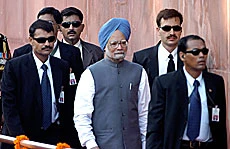
Amid tight security, Prime Minister Manmohan Singh unfurled the tricolor at the ramparts of the Red Fort. While addressing the nation, the prime minister vowed to “neutralize and smash” militants and urged Pakistan to crack down on cross-border terrorism.
In his 50-minute speech, the prime minister touched on a range of issues from economy to foreign policy but underlined the threats from extremists and separatists and the need for Pakistan to curb terrorists working against India from its soil. He sent out a strong message to Pakistan saying that the country had to take steps against cross-border terrorism or the Indo-Pak peace process would lose popular support. “We have taken several initiatives to be successful, these initiatives need an atmosphere of peace.”
“It is obvious that unless Pakistan takes concrete steps to implement the solemn assurances it has given to prevent cross-border terrorism, public opinion in India, which has supported the peace process, will be undermined,” he said.
Manmohan said all countries in our region must recognize that terrorism anywhere is a threat to peace and prosperity everywhere. “It must be confronted with our united efforts,” he added. Noting that the people of Jammu and Kashmir continue to face the wrath of terrorism, he said they have also seen new rays of hope for peace and progress.
“Terrorists want to undermine our growing economic strength, destroy our unity and provoke communal incidents,” Manmohan told the nation, just over a month after Bombay train bombings blamed on Muslim militants killed 183.
“We cannot allow this to happen... We will not allow the secular fabric of our country to be broken (and) we will leave no stone unturned in ensuring that terrorist elements in India are neutralized and smashed,” he said from a bullet-proof enclosure at the Mogul-built Red Fort in the capital.
“Let those who want to hurt us by inflicting a thousand cuts remember — no one can break our will... No one can make India kneel.” On Friday, the US Embassy in New Delhi said militants, possibly Al-Qaeda, may be planning a series of blasts around Independence Day. India dismissed the warning as “innocuous” but ratcheted up security even further.
Some 10,000-security personnel yesterday guarded the Red Fort while another 90,000 kept a vigil across Delhi, which was guarded during Singh’s address by military helicopters. Troops also occupied streets in Kashmir, where the smothering security and a strike called by Muslim separatists kept most people indoors.
One Indian soldier was injured in a land mine ambush in the Himalayan state’s Poonch district, officials said.
Anti-insurgency troopers were out in strength in several northeastern states where ethnic guerrillas have called a boycott of the freedom celebrations. Police and soldiers guarded key installations in Bombay. India blames rebels fighting its rule in Kashmir for the train blasts. Manmohan after the July 11 carnage said the attackers had support from “across the border” — a reference to Pakistan.
India accuses Pakistan of sponsoring the militants, a claim it denies.
“We have taken several initiatives in this regard, in particular with Pakistan. To be successful, these initiatives need an atmosphere of peace.” Islamabad’s Ambassador Aziz Ahmed Khan urged India to carry the process forward.
“Kashmir is the most serious of all other issues,” he told Headlines Today television in an interview broadcast yesterday.
“And now is the time to face the more serious issues and the best way to do it is to have a serious, concentrated, continuous dialogue so that we can tackle this issue,” said Khan, who completes his three-year stint later this month.
A highlight of the Prime Minister’s address was his fervent plea to political parties and leaders that they must learn to work together and build a consensus on national issues.