
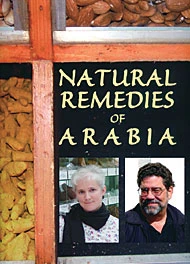
It is not often that one encounters a genuine labor of love, but the book “Natural Remedies of Arabia” (ISBN: 1-905299-02-8) by Robert W. Lebling and Donna Pepperdine is exactly that. Recently published by Stacey International (UK) with Al-Turath (KSA), “Natural Remedies of Arabia” encompasses three years of research and writing, and centuries of knowledge.
At its most basic, the book explains how herbs, spices, foods and other natural substances have been used by the people of the Arabian Peninsula and surrounding geographies to improve health. Don’t imagine, however, that the publication is a mind-numbing textbook. Narratives concerning the use of the various remedies are interspersed with scientific trivia, research data, historical tidbits and excellent photographs. The Natural Remedies section of the publication, is followed by sections on Natural Beauty, Recipes, a Glossary, Index of Common Ailments, Bibliography, and indexes listing both Latin and Arabic names.
Neither Lebling nor Pepperdine are strangers to the Middle East and the Natural Remedies of the Arabs. Lebling studied politics and anthropology at Princeton and is currently supervisor of Electronic Publishing at Saudi Aramco. He previously published an online Handbook on Arabian Medicinal Herbs (http://www.geocities.com/eyeclaudius.geoHERBALME.htm).
Pepperdine (www.herbaleducator.com) is an ESL (English as a Second Language) instructor with special interests in culture and health education. She received essential training in Natural Remedies from Canada’s Dominion Herbal College and is a Master Herbalist. Although she has now left the Kingdom, in the years she was here, Pepperdine spent much of her free time researching alternative medicines and therapies.
Pepperdine and Lebling chose to write a book on the topic of Natural Remedies of Arabia because they recognized that the regional knowledge of remedies and prophylactics found in nature was being lost. Most people were turning to pharmacies looking for manufactured drugs to cure their ailments. Unfortunately, in the Kingdom natural remedies are thought of as old-fashioned by the younger generation.
“When we step into a local herb shop, we enter a different world,” Pepperdine said. “We learn of medicinal plants and natural remedies that have been employed for generations. In both local herbal shops and pharmacies there are credible solutions. But, some of the old ways are being forgotten.”
In early 2002, Pepperdine set out to preserve the knowledge of the Natural Remedies of Arabia by distributing questionnaires throughout the Arabian Peninsula.
“The questionnaires asked families to explain how they, as well as their mothers and grandmothers used various herbs, spices and other substances in natural healing,” said Pepperdine. “The questionnaires also asked for specific remedies for conditions such as headaches, coughs and colds, sore throats, hair loss, fatigue and childbirth. The research project aimed to record the natural remedies of Arabia while they were still fresh in people’s memories.”
As the questionnaires were returned, it became obvious that the wealth of information collected begged to be shared. The project was expanded with Lebling contributing his talents to help analyze and organize the research material and eventually join with Pepperdine to write the book. For the most part, it is Pepperdine’s beautiful photographs that give the book a special Arabian flavor. And while there isn’t space here to list all the others who contributed to making this book a reality, what is apparent in reading the “Acknowledgments” in the publication is that a large team of Saudi and expatriate volunteers worked together to preserve this knowledge and leave a legacy to benefit humanity.
“In the Kingdom the book is available at Jarir Bookstores and other locations where Stacey’s books are sold. Outside the Middle East the book can be found through Amazon.com. There are talks now to release an Arabic version of the publication and we are also considering creating a small handbook to supplement this hard cover publication. The handbook would be useful when out in the market seeing the remedies first hand,” explained Lebling.
Dozens of Natural Remedies are discussed in the book, but Lebling’s Top 5 items that everyone should have in their “natural medicine chest,” are black seed, turmeric, garlic, honey and dates. The publication also tells about more unusual remedies such as Tarthuth. Known as Desert Thumb or Red Thumb, Tarthuth only emerges from the desert sands for a brief period in the spring each year. This parasitic plant is used to stop bleeding and as a cure for ulcers and other stomach ailments.
Even though certain plants are difficult to find outside the Arabian Peninsula, the practice of harvesting or importing the natural remedies is already in decline. The authors hope that with the book’s publication more people will be encouraged to go to shops selling natural remedies and spur a revitalization of the trade.
“There is also the possibility that investment could be made in farms or greenhouses that would specialize in the organic cultivation of herbs and medicinal plants locally,” commented Lebling. “While interest in natural remedies has been waning in Arabia, in the Western world many people are extremely curious about traditional remedies and the number of businesses focused on herbs and medicinal plants is growing annually.”
Increased community awareness of the effectiveness of natural remedies, coupled with a strong investment plan that included the training of sales staff, could allow a savvy investor to carve out a lucrative niche in the Saudi market. Lebling also pointed out that scientists worldwide are intensively researching the medicinal properties of herbs, plants and other cures found in nature.
“We created the book for information and entertainment purposes. That said, the fact is that people have passed this knowledge from generation to generation because these remedies work,” Lebling observed. “Throughout the book we added information on the research being done in regards to these remedies. There are scientific papers linked to every remedy we mention. The pharmaceutical industry was born as a result of the interest in taking a natural remedy and synthesizing it to create a drug. Look at aspirin. Increasingly now, modern medicine is trying to find inspiration in traditional cures and we hope that Arab scientists will be encouraged to join that endeavor.”