BEIRUT, 20 August 2006 — Kfar Shouba is several miles away from the Israeli border, and 70 percent destroyed. Craters, blown up bridges, and quick fix detours, mar the roads leading to the village. “This war against Israel is not just a matter of principle, it’s personal,” said Afif Diab, a journalist for Al-Jazeera television and who happens to be from Kfar Shouba.
Diab wanted to come back to the village to see if his home was still standing. “My father started to build this house in 1967, and in every war with Israel they destroyed our home. We have rebuilt it over six times,” said Diab with a mixture of frustration and sadness. “When the Israelis finally left in 2000, I started to fix the garden, it was full of big craters from the shelling, thinking I will have plenty of time to fix the house later.”
As his luck would have it, the major damage to his home was the garden, full of small craters, electrical wires fallen from poles, and trees leaning on the house for support. To add a little humor to the situation, a village horse was mangled in the wires unable to move. Inside the house the only thing hanging on the wall is a framed picture of a young man, and big rusted keys next to them. The young man is Diab’s brother killed by the Israelis when he was 20 years old. “If the army enters Kfar Shouba in the next couple of days, it would be the first time in 40 years.”
As you walk around the village, you see the few families that have come back trying to clean their homes, if they are still standing. “It took me two days to clean the house,” said Um Ziyad about her small two room home. She and her husband came back from the school that sheltered them and many others in Hisbaya. “We stayed here for nine days, then they started to bomb the houses around us, so we had to leave in the middle of the night while they were bombing,” she said. “I was born in war in 1957, and have known nothing else. One of my first memories of war was when I was 13, and had to hide in Shebaa Farms with my little brothers.”
“We can’t afford to fix this house, how many times are we going to do that? Maybe next time they can give me a mobile home that I can take with me!” said Um Ziyad jokingly.
Sitting in her newly cleaned home, with huge cracks in the wall, she still had her sense of humor and hospitality intact, and would not let us leave without drinking a cup of bitter coffee.
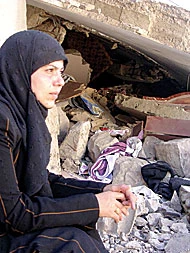
The old lady down the street was not in the same mood, she was distraught. Fawzia Khabbaz lost everything. She had no family, no children to help. As she stood at the door of her home in the midst of the rubble, she kept on muttering more to herself than to us that everything had to be thrown away, her little shop and only source of income destroyed. “Who is going to pay for this? Who is going to help me? No one is,” said Khabbaz crying as she stubbornly tried to clean the rubble that used to be her home.
“Those of us who lost their homes should not complain, we are still looking for the dead, the rescue team has found seven so far and is still looking for others. Those families have lost the irreplaceable, we can always rebuild,” said Randa Sulaiman, her home leveled to the ground by an Israeli air raid. “I had redecorated the house less than a month before the war, but its OK. This will be the fifth time we rebuild our home.”
Bullet casings and empty boxes of bullets with Hebrew inscriptions on them are evidence that Sulaiman’s home was the scene of some intense fighting between Hezballah fighters and Israeli soldiers.
Amid the destruction, the biggest controversy in the town was the fact the head of the municipality, Abu Bilal, had run away in the first days of the war without asking about anyone or even taking his old mother with him.
Abu Bilal happens to be Diab’s uncle. In every home we visited they were talking about how to oust the elected municipal council, and vote for a new one. Anger was ripe in the town on how things were handled during the war by “officials”.
Khiam a Symbol of Resistance
Half an hour away from Kfar Shouba is Khiam. The village has become a symbol of resistance and victory for Hezbollah and a tourist site after the year 2000. Today, there is nothing left, not a single building untouched by the Israeli bombs. As we drove up to the prison, the destruction was total, with banners on top of the rubble saying “made in America”. There are few that doubt the source of all the destruction here. A lady with a huge smile stopped us on the road and gave us plastic roses, in celebration of victory, she said, everyone gets a flower. People were greeting each other in the street, asking about each other’s health, life, and home, assessing the degree of damage.
The Khiam prison was a major focus of the Israeli attack. Everything was leveled to the ground with the exception of some army vehicles left by the Israelis, and two prison cells turned into a prayer room and storage room by Hezbollah. An army unit and weapons inspectors arrived at the site to search for banned weapons such as cluster bombs and check levels of radioactivity.
The south is still a dangerous place to be with 30 percent of the bombs Israel used still in the ground unexploded. Radio and television stations are still warning the public not to go near unidentified objects that could look like rocks or toys.