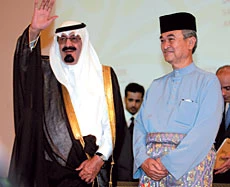
KUALA LUMPUR, 1 February 2006 — Saudi Arabia and Malaysia yesterday vowed to forge closer economic ties by promoting joint ventures in vital sectors and by increasing investments in both countries.
Custodian of the Two Holy Mosques King Abdullah, who arrived here Monday on a three-day visit, urged Malaysian businessmen to make use of investment opportunities in Saudi Arabia. Riyadh is seeking foreign investment worth $624 billion in vital sectors such as petrochemicals, gas, power generation, desalination, agriculture, information technology and railways.
King Abdullah told a gathering of Malaysian and Saudi business leaders here that the economies of both countries were undergoing a period of rapid growth and prosperity. “There are many investment opportunities available that I hope you will avail yourselves of in order to strengthen our economic ties,” the king said.
“The governments of Saudi Arabia and... Malaysia have done their duties with regard to implementing the legal framework to open the doors in both countries for investments. What remains is for businessmen to take the initiative,” he added.
King Abdullah received from the International Islamic University in Malaysia an honorary doctorate degree in Islamic development and a royal medal of the first order for strengthening Islamic unity. In its citation, the university commended Saudi Arabia’s leading role as a financial center in the Islamic world. It also noted the king’s efforts to promote both education and knowledge.
Addressing a dinner banquet hosted by Malaysia’s King Tuanku Syed Sirajuddin on Monday, King Abdullah pledged that he would work with all OIC countries to implement the resolutions taken at the Makkah summit in December. “We also look forward to working together for the progress of Islam and Muslims,” he told the gathering at the national palace.
Also yesterday, Saudi Arabia and Malaysia signed two government-level agreements, one to avoid double taxation and prevent tax evasion; and the other to promote scientific and cultural cooperation.
Malaysian Prime Minister Abdullah Badawi, also addressing the business summit, hailed bilateral ties as excellent and urged businesses to take advantage of them. “Although Malaysians and Saudis live in very different societies and cultural environments, we have a very strong bond in our Islamic faith and brotherhood of the Ummah,” he said. “We should take advantage of these strong ties to generate productive cooperation and collaboration.”
Malaysia’s trade with Saudi Arabia amounted to about $1.8 billion last year but Badawi said there was room for growth. “There remains much untapped potential in trade and investment,” he said. “We must take initiatives to develop these potentials together, most desirably in the form of joint ventures.”
Badawi said his country was anxious to participate in the SR100 billion economic city in Rabigh, which was launched by King Abdullah last month. Malaysia is also keen on developing industrial and free-trade zones as well as tourism projects.
Badawi also noted that Malaysia’s oil giant, Petronas, which has considerable international expertise, wanted to expand its operations to the Kingdom. “I know that the company is open to any proposals from Saudi Aramco,” he said.
The prime minister said his country placed great emphasis on strengthening relations with Saudi Arabia. He hoped that the new agreements concluded by the two countries would pave the way for closer cooperation.
“With Malaysian expertise and Saudi capital, the two countries can undertake projects, not only in the Kingdom but also in third countries,” he explained.
Badawi said Malaysian entrepreneurs were specifically looking for opportunities in infrastructure projects such as construction, electricity, shipyard building, maintenance and water desalination.
He said Malaysia’s economy had become a private-driven sector and had shifted from an import-oriented to an export-based one, and developed from labor-intensive to capital-intensive, adding value to the goods produced.
He said the country was now embarking seriously upon establishing knowledge-based industries. “Malaysia is very actively promoting the development of the Information and Communications Technology industry. We have established the Multimedia Super Corridor, which is an environment especially created for companies and corporations wishing to develop creative IT and multimedia products and services.”
Badawi also praised Malaysia as an investment destination, lauding the country’s positive economic outlook. “In 2004, the country registered a GDP growth rate of 7.1 percent. In 2005, it was 5.5 percent.
“The near-term outlook for 2006 remains optimistic, with global demand expected to be sustained. The Malaysian economy is forecast to grow between five and six percent in 2006,” he added.
Badawi said that the king’s visit marked “a very high point” in bilateral relations, particularly in the area of trade. “We can lead as an example of what we Muslims can achieve when we are united, in terms of the future and prosperity of our countries.”
The business summit saw the signing of five memorandums of understanding. The first agreement, worth SR750 million, is in Strategic Joint Projects and Investment Funds. It was signed by Ghassan Al-Sulaiman of Siraj Capital and Venture Capital Bank and Tan Sri Dato Muhammad Hashim, CEO of Johor Corp.
Al-Sulaiman signed another SR1 billion accord in Real Estate Investment Fund with a Malaysian private company. The third MOU, worth SR375 million, in research and development and the manufacturing technology of Saudi mobiles was signed by Ghazi Al-Shalhoub, president of the Saudi Arabian Television Manufacturing Company. Zainudin Salleh and Norhamzah Bin Nordin from the M dot Mobile Sdn. Bhd signed the accord for the Malaysian side. The fourth MOU in developing white board e-learning is worth SR75 million and was signed by Tarek Al-Kasabi, chairman of Al-Kasabi Company, and Dato Fazli Yusof, CEO of Pintar Learning Sdn. Bhd. The fifth was for setting up a SR30 million company in the field of information technology.