
Sri Lanka is keen on strengthening its bilateral co-operation on trade and investment with the Kingdom.
“This year, our focus is to enhance the two-way trade and investment between the two countries.” A.M.J. Sadiq, Sri Lankan ambassador, told Arab News.
Bilateral trade between the two countries was to the tune of $150.4 million in 2004, with the balance heavily in favor of the Kingdom. The island’s exports to Saudi Arabia stood at $30.8 million while its imports were estimated at $119.6 million. Crude oil and petroleum products accounted for 74% of Saudi exports while urea, copper, other metals and chemicals made up for the balance products. On the other hand, two commodities, namely tea (69%) and desiccated coconut (12%) dominated Sri Lanka’s exports to the Kingdom. The other significant exports were automobile tires, wooden fiberboard, vegetables and garments.
Ambassador Sadiq, commenting on the trade imbalance and the preponderance of tea and petroleum in the trade, has emphasized the need for diversification of trade. In particular, he has urged Sri Lankan exporters of apparel, porcelain ware, gems and jewelry, leather products and processed foods to explore the Saudi market which is rapidly expanding, backed by sustained high petroleum prices.
Sadiq is also encouraging Saudi investors to take a closer look at Sri Lanka, as a highly profitable and safe haven for their investment. The constitution of Sri Lanka guarantees the protection of foreign investment. The services sector accounting for over 55% of the country’s GDP, offers the most extensive opportunities for foreign investors, given Sri Lanka’s highly literate and trainable work force, with a good command of the English language and a large talent pool of highly skilled engineers, accountants and IT professionals.
Moreover, the island, endowed as it is with its enchanting natural beauty and geo-strategic location off the southeast coast of the Indian Subcontinent at the junction of major international sea routes, has attracted intrepid seafarers, adventurers, merchants and European colonial powers alike over the centuries.
Financial services such as banking and insurance, the tourism and leisure sector, port and shipping services, IT and telecommunications provide ideal openings for foreign investors. Sri Lanka does not restrict foreigners from purchasing land unlike many other countries. Foreign investors or companies can own up to 100% of local company equity, freely remit dividends and profits abroad. The country has strong and independent regulatory institutions, such as the Central Bank, Securities & Exchange Commission and the Auditor General’s Department which facilitate capital market development and promote a free and fair business friendly environment.
The Colombo Stock Exchange was rated the second best performing in the world in terms of capital appreciation in 2004. The improved earnings outlook and the healthy financial fundamentals, particularly of the blue chip companies listed on the stock exchange has prompted the inclusion of Sri Lanka by the California Public Employees’ Retirement System (CALPERS), the largest pension fund in the USA, in its emerging markets investment eligibility list. The upbeat foreign investor sentiment with two successful initial public offerings (IPOs) in the services sector last year, attracting a new investor base impacted positively on market activity. Shell, Caltex, Holcim, Ansell, BHP Steel, Citi Group, Caterpillar, NTT, Telekom Malaysia are some of the major multinational corporations which have invested in Sri Lanka, most of them in the last decade. Other big players such as Unilever, Glaxo, HSBC, Nestle, Procter & Gamble, British American Tobacco (through its local subsidiary Ceylon Tobacco) have had a long-term presence in the island, some of them dating back to the British colonial era and have played a vital role in the national economy. The Al-Mashal Investment Group of the Kingdom has taken a 10% stake in the Commercial Bank, a leading private bank, which has been ranked as the best commercial bank in Sri Lanka.
The Free Trade Agreement signed with India in December 1998 allows duty free imports from either country, barring a limited number of items on the negative list. Items eligible for duty concession and tariff reduction under the FTA only require a minimum 35% value addition in the exporting country. Many foreign exporters seeking to penetrate the vast and highly lucrative Indian market have taken advantage of the Indo-Lanka FTA to invest in manufacturing plants in Sri Lanka. Saudi manufacturers and exporters wishing to export their goods and services to India would find in Sri Lanka, a cost-effective and convenient halfway house, to set up their base.
Sri Lanka signed the General Agreement on Economic, Trade, Investment, Scientific, Technical, Cultural, Youth and Sports Cooperation with the Kingdom in December 2003. The agreement has paved the way for new areas of cooperation. The ambassador has plans to initiate action to sign agreements with Saudi Arabia on the Avoidance of Double Taxation and Investment Promotion & Protection which would enhance bilateral trade and investment.
He has also proposed to negotiate a new Bilateral Air Services Agreement to replace the existing pact, taking into account the rapid growth of passenger traffic between the two countries. This would enable the two national carriers, Saudia and SriLankan Airlines, to enhance flight frequencies between the two countries. SriLankan Airlines currently operates five flights per week from the Kingdom to Colombo providing convenient connections to Indian cities and Southeast Asian destinations. The flights are on Mondays and Wednesdays from Riyadh and on Tuesdays, Thursdays and Sundays from Dammam. SriLankan Airlines has expressed keen interest to expand its services to Jeddah, which would not only give a major boost to expanding bilateral trade, Jeddah being the commercial hub of the Kingdom, but will also be a boon to Sri Lankan Haj and Umrah pilgrims.
Sri Lanka and Saudi Arabia established diplomatic relations on Dec. 1, 1974. The first ambassador of Saudi Arabia was appointed in August 1977, with residence in New Delhi. Sri Lanka established its resident mission in Jeddah in November 1981 with Mohamed Riyal Thassim as its first ambassador. The embassy was shifted to Riyadh in 1985. The Kingdom started its resident mission in Colombo in 1995 and upgraded it to ambassadorial level in 2003 with the appointment of the current envoy, Mohamed Mahmud Al-Ali as its first resident ambassador in Sri Lanka. The Sri Lanka Consulate in Jeddah was set up in 1997, which was elevated to consulate general in the following year.
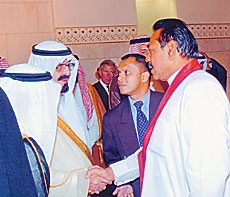
Sadiq said that Sri Lanka enjoys excellent relations with Saudi Arabia, which have been further consolidated through frequent high level visits from the island. Last August, President Mahinda Rajapakse visited the Kingdom as prime minister and greeted the Custodian of the Two Holy Mosques King Abdullah on his accession to the throne.
The presence of a 500,000 strong Sri Lankan expatriate community in the Kingdom, the largest Sri Lankan worker population overseas, is a significant feature of bilateral relations, and bears testimony to the immense respect and esteem that the people of Saudi Arabia have for Sri Lankans. Worker remittances from the Middle East account for over 55% of total private transfers in the Sri Lankan economy. In 2004, this figure recorded an 11% increase to $1.564 billion and the number of Sri Lankans taking up foreign employment last year was 221,000 which was an increase of 8,000 compared to 2004.
The two largest state-owned commercial banks, namely Bank of Ceylon and People’s Bank as well as a leading private bank, Seylan Bank maintain representative offices in the Kingdom to provide services to the Sri Lankan community in sending remittances to their families back home. Top Saudi banks, such as the Arab National Bank and Bank Albilad also offer special services to expatriates for fast and convenient money transfers.
The Sri Lanka Bureau of Foreign Employment, an organization under the Ministry of Labor Relations & Foreign Employment is tasked with co-ordination of the training and deployment of Sri Lankan workers abroad. Minister of Labor Relations & Foreign Employment Athauda Seneviratne has proposed to visit the Kingdom later this month with a high powered delegation to meet his counterpart and other officials of institutions, including the Saudi National Recruitment Committee (SANARCOM), the apex body of manpower recruitment agencies in the Kingdom, to discuss the securing of more employment opportunities for Sri Lankans in Saudi Arabia, the welfare of the expatriate community and other matters of mutual interest.
Sadiq recalled with deep gratitude the magnificent response from the Saudi government, NGOs and ordinary citizens of the Kingdom to the unprecedented devastation caused by tsunami waves which hit the southern and eastern coastal belt of Sri Lanka on Dec. 26, 2004. This natural calamity wreaked havoc on the country, resulting in the loss of over 30,000 lives and displacing about half a million people. It caused the destruction of infrastructure worth $1 billion along two thirds of the island’s coastline. The ambassador remarked that the tsunami disaster brought the two countries together as never before.
The Kingdom sent eight flight loads of relief material and is currently building 1,000 houses for the tsunami victims.
The Saudi Red Crescent Society (SRCS) which opened an office after the disaster, donated 15 ambulances, and sent medicines and medical equipment to hospitals in the tsunami affected areas. It has arranged to distribute 300,000 sets of school uniforms for tsunami-affected children shortly. The Saudi ambassador, Mohamed Al-Ali, the embassy staff and officials from NGOs such as the SRCS, International Islamic Relief Organization (IIRO), World Assembly of Muslim Youth (WAMY) and Shabab Group were on hand in the tsunami ravaged areas to console the survivors and provide them immediate relief. The chairman of Kingdom Holding Company, Prince Alwaleed ibn Talal who visited the island last March, donated $300,000 to the President’s Fund. On their part, Sri Lankan expatriates across the Kingdom united as one family and collected SR587,000 and dispatched 10 container loads of relief supplies to Colombo for distribution among the victims.
Sri Lanka has a strong and vibrant private sector which since 1977, when market oriented economic liberalization reforms were initiated, has spearheaded the economic transformation of the nation, from a principally agricultural export economy to a widely diversified industrial/service sector based one.
From time immemorial, the island of Sri Lanka has captivated the imagination of people across the world. The ancient Greeks called it Taprobane.
The island’s rich variety of spices such as cinnamon, cardamom, nutmeg, cloves and its exquisite rubies and sapphires have been a magnet attracting droves of foreign merchants, casual visitors and indeed European colonial powers engaged in empire building. Sri Lanka is a tourist destination with a difference — its range of products is truly amazing. Besides the beaches and water sports, dense tropical rain forests, cascading waterfalls and mist-draped mountains, this small island boasts of no less than seven sites declared as World Heritage Sites by UNESCO.