
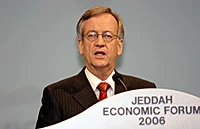
JEDDAH, 13 February 2006 — The chairman of the supervisory board of Siemens presented a formula for sustaining development in a global economy. It included embracing diversity, investing in education and training and having adequate reliable infrastructure. The title of the session was “Identity and Diversity in industry,” and Heinrich Von Pierer talked about how multinational corporations can face a challenge in meeting the demands and expectations of the global consumer despite the seemingly universal product. Long gone are the days of mass production where one product is considered suitable for everyone. Today’s industrial companies face a new era in which identity and diversity seem to play an increasingly central role in societies worldwide.
Pierer spoke about the debate over human rights in relation to business and industrialization saying that improving the life of humans can be achieved within the system and considered opening the door for dialogue as a good way for bringing diversity. Diversity is a good step and it is a word that describes the world economic system, according to Pierer. He also emphasized on respect being a key word for companies working in different countries. Respecting the local cultures, religion and traditions is essential for a company to succeed and, in diversifying, each country should enrich and nurture its identity, according to Pierer. He referred to the current conflict over the offensive cartoons published by a Danish newspaper and republished by other European newspapers saying that there are written laws and unwritten laws and we have to understand those. “Freedom of the press is a basic right for everyone but with that freedom there are obligations that include responsibility, sensitivity and respect and it would be difficult to continue working without tolerance and respect,” he said.
Siemens is a German company that works in 190 countries. It has established a presence in the Middle East as early as 1859. Pierer said that there are around 200 German companies working in Saudi Arabia. One of the reasons that made German companies gain a good reputation here is patience and hard work, which is not about getting the deal as much as establishing a long-term partnership based on respect and cooperation. He said that Germany is committed to the region and it is the second exporter to Saudi Arabia after the United States. One of Siemens’ projects in Saudi Arabia is an under sea cable which is being implemented. He approves of Saudi Arabia’s Saudization drive saying that 40 percent of the employees in Siemens company in Saudi Arabia are Saudis.
Besides embracing diversity as one of the key components for the success of a company, Pierer said education and infrastructure are another two factors necessary for economic growth. “Education is a key to long-term competitive advantage,” he said. True competition today is in having the best education system which would determine the future of a people. Education in all its forms whether gaining knowledge, skills or life-long learning is important for development because societies are developing quickly and who ever stops learning stops progressing. Siemens spends $600 million on educating and training its employees because it is convinced that education is a basic factor for international competition.
The third theme that Pierer presented as a key for sustainable growth and economic development is having an adequate reliable infrastructure. This infrastructure has to be secure, meaning fully reliable, affordable and environmentally friendly in order to build up a strong society. He said that Saudi Arabia is experiencing a fast population growth and a migration to the cities, which requires an increase in water supplies and providing continuing solutions that meet the demands of the coming generations. He also said that there is a need for diversifying future income sources. In the end he concluded by saying that globalization does not have to be seen as a threat but as a way to improve society and that, “cultural diversity is a rich asset for any company.”