
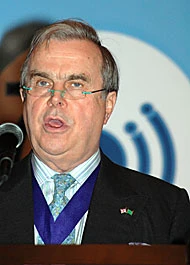
JEDDAH, 13 February 2006 — Private Public Partnerships (PPP), said Dr. Nahed Taher, CEO of Gulf One Investment Bank, were midway between government ownership and privatization. Introducing the topic at the JEF on Saturday, she thought that he UK model was a suitable solution for reducing cost and efficiency of GCC public services. The theme was amplified by the Lord Mayor of London, Alderman David Brewer in his speech.
The Saudi experience with private finance of public projects had often had problems. Large losses in capital projects were transferred to the private sector by the government to the private sector.
Dr. Nahed noted that high oil revenues had considerably increased public allocation to infrastructure and energy projects. “The increase in corporate loans in the region incrementally per annum is under $7 billion. Required funding however for major projects is $60 billion per annum,” she said. Targeting local liquidity was not the solution. “We still have to find a strategic partnership with international parties not only for the capital, but also for the experience and know how.”
Brewer said that Saudi Arabia “could rely on its natural resources with a lopsided economy or go down the path of creating a more balanced economy.” He pointed out that the experience of international companies and experts in the City of London, especially in the area of PPP’s, was something the Kingdom could usefully call on. The diversity of skills and the creativity of the international knowledge in the City workers produced inventive and practical solutions because of their very diversity. Skills outside the local work and business environment were now essential in a global economy. It was vital to get the right credentials. “If you don’t know much about Shariah law, it is difficult to design a Shariah-compliant product.”
Brewer described Saudi plans for healthcare and infrastructure as “truly breathtaking. “To cope with expanding population, plans include 20 hospitals and 250 clinics in the next five years, 3000 schools, 12 desalination plants and a rail network.” The Kingdom will need a total investment of $624 billion in infrastructure and $800 billion in privatization opportunities over the next 15 years. “You can afford it, but,” he warned, “with infrastructure projects there is a massive on-cost in maintenance, replacement and upgrading, perhaps doubling that bill over 30 years.”
Brewer indicated that the UK experience showed that better and focused management by the private sector more than offset this amount, produced savings to government and reduced the bill to the taxpayer. The UK had invested and sustained high quality schools, hospitals roads to the value of 50 billion euros in 600 projects since 1993.
PPP funds 6 billion euros investment per year in UK infrastructure which amounts to 12 percent of the annual public investment. “The National Audit office has assessed that savings via PPP over conventional procurement amount to 17 percent. Its 2003 assessment reported that 75 percent of projects were completed on time and to budget.”
In a follow-up session hosted by UK Consul General Carma Elliot , Dr. Sami Baroom outlined the immense capital investment in infrastructure that Saudi Arabia faces in the next 20 years. The total capital investment in infrastructure alone, he said, totaled about SR520 billion as well as electricity SR450 billon, gas and water SR330 billion and SR1 trillion in housing services in Riyadh alone.
The UK and Saudi share similarities of their fiscal structure and he felt that this made UK firms and systems particularly compatible with Saudi hopes for development. What makes PPP financing so attractive to the Saudi government is that the UK model is well tried and documented and that the government retains ownership of the projects. Brewer said that in making projects work, defining a PPP in terms of perception and what it could deliver was the first step. The public sector might make the private sector automatically think it would lead to job losses. It was probably the reverse, for PPP’s often create jobs. Public Relations had to be well ordered and able to sell the advantages and dissipate misconceptions from the start. Capital costs and maintenance costs he said were often kept separate in conventional budgets. The pressure was always to cut the capital and this could lead to low quality construction with the consequent problems.
A suitable legal framework was essential, said Brewer, to reduce the risk imbalance and a common approach to risk allocation.
“It is also important to build a powerful set of champions amongst the public, politicians and the media,” he said. One successful model was a dedicated PPP unit with power to create policy, guidance and see the projects through.Brewer last visited Jeddah thirty years ago. “The most immediate change one sees is simply the space, the size of the city,” he said. “It has become a bustling modern city with a vibrancy that I did not experience before.”
He thought that the new high level of revenue and the ongoing demand for oil from China and India put the Kingdom in a good position to invest in infrastructure. He had received a very positive reception to the idea of PPPs as the answer to how to develop infrastructure efficiently.
Meeting senior students from colleges gave him great confidence in the abilities and willingness of young Saudis to learn and develop in the financial sector.
“The finance industry will drive job creation in the Kingdom,” he said, “and other service sectors will grow on the back of it.”